 Dopo aver visto come funziona il Tasting & Demo Exam, è il momento di parlare della parte più corposa del percorso per diventare Certified Cicerone®: il Written Exam.
Si tratta della prova che pesa maggiormente sul voto finale e che copre praticamente tutto il programma del Syllabus: servizio, stili, degustazione, ingredienti, processo produttivo e abbinamenti gastronomici. È anche la parte dell’esame che, leggendo blog e gruppi di discussione online, viene descritta più spesso come uno scoglio quasi insormontabile.
Dopo averlo sostenuto, la mia impressione è diversa. È sicuramente un esame impegnativo, che richiede una preparazione ampia e ben organizzata, ma con il giusto metodo è decisamente abbordabile. In questo post cercherò di spiegare come funziona concretamente: come ci si iscrive, come è strutturato, quali argomenti copre e come mi sono preparato per affrontarlo.
Come si accede al Written Exam
Questa parte dell’esame si può sostenere online, iscrivendosi a una delle sessioni pubblicate sul sito del Cicerone. Si tratta di sessioni live monitorate da remoto tramite un sistema di proctoring.
Le sessioni si svolgono in orari prestabiliti, i partecipanti possono collegarsi potenzialmente da qualsiasi parte del mondo. In genere ci si iscrive alla sessione più comoda in base al proprio fuso orario, ma teoricamente è possibile partecipare a una qualsiasi di quelle disponibili.
Il costo è abbastanza elevato: 250$ per il primo tentativo, 200$ per i successivi. L’unico requisito richiesto è aver superato l’esame per diventare Certified Beer Server (CBS). A differenza del Written Exam, che ha sessioni programmate, il CBS è un test online a risposta multipla che può essere sostenuto in qualsiasi momento.
Chi ha un minimo di conoscenza della birra e dei suoi principali difetti supera l’esamae CBS senza particolari problemi. L’esame dura 30 minuti e comprende 60 domande a risposta multipla; si passa rispondendo correttamente ad almeno 45 domande (75%). Il costo è di 79$.
Il Written Exam è disponibile in due lingue: inglese e spagnolo. Chi non è madrelingua può richiedere l’autorizzazione a utilizzare un traduttore online durante l’esame. La richiesta va presentata prima della prova, in modo che il Cicerone possa approvare preventivamente il sito che verrà utilizzato per la traduzione.
L’infrastruttura con cui viene gestito l’esame è piuttosto rigorosa. Durante tutta la prova vengono registrati sia il volto del candidato sia lo schermo del computer; eventuali comportamenti ritenuti anomali possono comportare la revisione o l’annullamento dell’esame. Viene inoltre richiesto di mostrare e registrare un documento di identità.
Quanto pesa il Written Exam sul voto finale
Come ho già spiegato in un post precedente, il Certified Cicerone® è diviso in due parti. Le due prove (colorate in verde e celeste nella tabella sotto) si possono sostenere in qualsiasi ordine.
Il Tasting & Demo Exam incide relativamente poco sul voto finale, che di fatto viene determinato quasi interamente dal risultato del Written. A differenza di quest’ultimo, però, il Tasting richiede un punteggio minimo del 70% per essere superato.
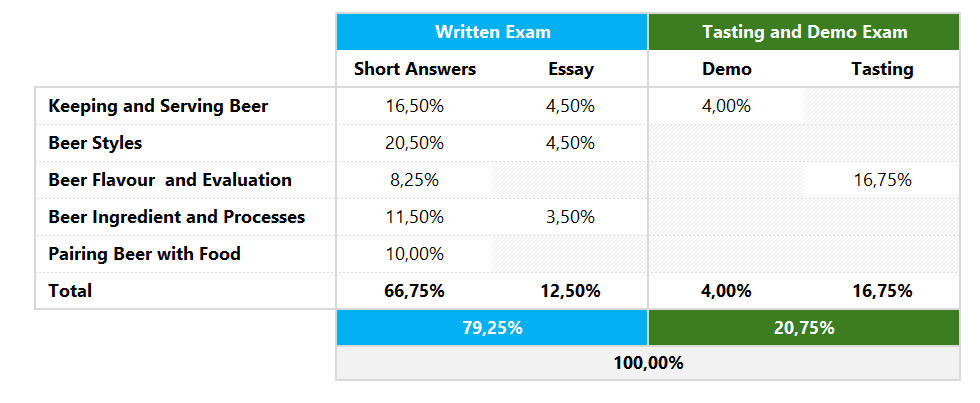
Non esiste invece una soglia minima richiesta per superare il Written Exam. Tuttavia, facendo due conti, un punteggio inferiore al 75% renderebbe matematicamente impossibile raggiungere l’80% complessivo richiesto per ottenere la certificazione.
Come è strutturato il Written Exam
Le domande del Written Exam coprono tutti gli argomenti del Syllabus, suddivisi in cinque grandi aree. Ciascuna ha un peso diverso sul voto finale e un numero differente di domande:
- Keeping and serving beer
- Beer Styles
- Beer Flavours and Evaluation
- Ingredients & Process
- Beer & Food Pairing
Oltre alle classiche domande a risposta multipla o a quelle che richiedono una risposta di una o due parole, l’esame comprende anche tre mini-saggi. La sezione Beer & Food Pairing contiene inoltre una domanda a risposta aperta: non è una risposta multipla, ma nemmeno un elaborato lungo come i mini-saggi. Il candidato può scegliere quale svolgere tra tre tracce proposte.
Tenendo conto di questa suddivisione, dei pesi riportati nella tabella precedente e della struttura del sample exam pubblicato dal Cicerone, possiamo rappresentare la struttura del Written Exam secondo lo schema seguente:
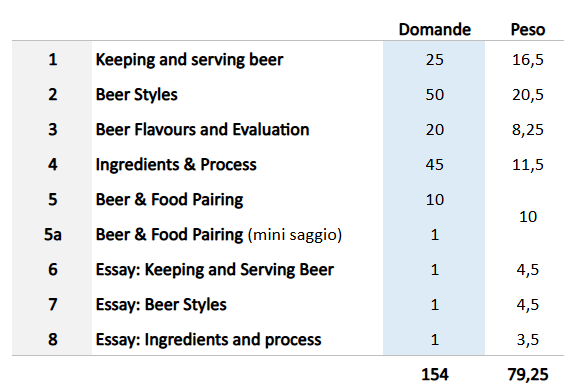
Il numero esatto delle domande può variare leggermente da una sessione all’altra. Più o meno, però, viene richiesto di rispondere a 150 domande in 180 minuti. Di queste, tre sono mini-saggi che richiedono risposte dell’ordine di 1000-2000 battute; una è invece una domanda a risposta aperta, inserita nella sezione Beer & Food Pairing.
L’area a cui viene attribuito il peso maggiore è Beer Styles. Considerando anche il mini-saggio dedicato, arriva a rappresentare circa il 25% del punteggio totale del Written Exam. Beer Flavours and Evaluation pesa meno nella prova scritta; il suo contributo diventa invece molto più importante nel Tasting & Demo Exam, per ovvie ragioni.
Se ipotizziamo di dedicare circa un’ora ai tre mini-saggi (20 minuti ciascuno), rimangono 120 minuti per rispondere alle altre 150 domande. In pratica, meno di un minuto per domanda.
Può sembrare poco. In realtà la maggior parte delle domande è a risposta multipla oppure richiede una risposta composta da una sola parola. Con una buona preparazione, molte si risolvono in pochi secondi; il tempo risparmiato può essere utilizzato per quelle più impegnative o sugli argomenti che si conoscono meno.
L’interfaccia non permette di navigare liberamente avanti e indietro tra le domande. È però possibile contrassegnarle come “da rivedere” e tornarci in seguito. L’obiettivo, naturalmente, è arrivare alla fine delle tre ore senza averne lasciata nessuna in sospeso. Non ho idea di come vengano valutate le domande lascite in sospeso.
Quando ho sostenuto l’esame ho consegnato con circa mezz’ora di anticipo. Non perché io sia un fenomeno, semplicemente perché il tempo a disposizione è adeguato se si arriva ben preparati.
Rimane un esame stressante, ma personalmente l’ho trovato meno impegnativo del Written Exam del BJCP, che dura la metà del tempo. Nel Written del BJCP bisogna scrivere tantissimo in pochissimo tempo; quello del Cicerone, tutto sommato, lascia qualche minuto in più per ragionare, i ritmi sono meno serrati e, soprattutto, non si scrive a mano.
Come prepararsi al Written Exam del Cicerone
La fonte primaria per capire quali argomenti studiare è, ovviamente, il Syllabus, disponibile sul sito del Cicerone.
Se si parte da zero, questo è un esame decisamente impegnativo. Non esiste un unico manuale che copra tutto il programma: bisogna studiare da più fonti. L’unica eccezione è la parte sul servizio, coperta quasi integralmente dal Draught Beer Quality Manual, pubblicato gratuitamente dalla Brewers Association e scaricabile in PDF.
Per gli stili bisogna imparare a menadito le linee guida del BJCP. Contengono anche una breve introduzione storica per ciascuno stile, più che sufficiente per quello che viene richiesto al Written Exam del Cicerone.
Per ingredienti e processo la situazione è un po’ più articolata. A chi parte da zero suggerisco un buon manuale di homebrewing, come Fare La Birra In Casa, scritto da me e Angelo Ruggiero, oppure How to Brew di John Palmer. Entrambi coprono anche i difetti della birra con un livello di approfondimento più che sufficiente per il Written Exam.
Nel mio caso partivo dalla preparazione del Written Exam del BJCP. Per il Cicerone mi sono quindi concentrato quasi esclusivamente su servizio, spillatura e abbinamenti. Sul resto avevo già una preparazione piuttosto solida.
Gli abbinamenti li ho studiati soprattutto su The Brewmaster’s Table di Garrett Oliver, un libro che credo si trovi ormai soltanto usato. In alternativa ci si può arrangiare abbastanza bene anche con materiale vario disponibile online.
L’abbinamento birra-cibo è l’argomento su cui ero (e sono tuttora) meno preparato; molte risposte, però, si riescono a dedurre con un po’ di ragionamento, una volta capiti i criteri principali di abbinamento (spoiler: le saison vanno bene con tutto). Inoltre, la performance su questa area pesa relativamente poco sul voto finale. Anche sbagliando la metà delle domande di questa sezione, se si è bravi sul resto si supera l’esame senza particolari problemi.
Esistono anche corsi e materiali ufficiali del Cicerone (BeerSavvy®), acquistabili a pagamento. Io non li ho utilizzati, ma chi li ha seguiti me ne ha parlato molto bene. Personalmente non li ritengo indispensabili: con il materiale gratuito disponibile online e un paio di buoni libri ci si prepara senza particolari difficoltà.
L’esame non è facile, ma nemmeno impossibile. Del resto, è soltanto il secondo livello di un percorso che ne prevede quattro. Direi che il livello di difficoltà è assolutamente adeguato.
Dal punto di vista pratico, ci sono diversi modi per esercitarsi all’esame scritto. Se non si vuole andare sul materiale ufficiale del Cicerone a pagamento, ci sono diverse alternative in rete. Ho trovato, ad esempio, questa serie di domande in stile Cicerone, complete di risposte corrette. Qualche risposta secondo me è sbagliata, ma l’aspetto positivo è che la maggior parte delle risposte sono facilmente verificabili sui manuali di stile o da altre fonti.
Mi sono trovato bene anche usando l’intelligenza artificiale per la preparazione dell’esame. Ho fornito in input il sample test del Cicerone e varie fonti per formulare le domande (come le linee guida BJCP e le mie slide sui difetti) per creare il contesto, poi ho chiesto di creare un simil-Written-Exam con domande a risposta multipla. All’inizio si può provare anche con le varie sottosezioni, senza necessariamente iniziare con 150 domande.
Me lo sono poi fatto correggere dalla AI che mi ha indicato le risposte che secondo lei erano corrette. Ovviamente le risposte non vanno prese sempre per oro colato ma, in generale, se ben alimentata, l’IA ci prende abbastanza.
Mi sono allenato con l’IA anche per la stesura dei mini-saggi. Ho chiesto di farmi una domanda su uno dei temi d’esame, ho risposto con un testo scritto in inglese e me lo sono fatto correggere, come se fossi ad un esame Cicerone. Ho ricevuto consigli e osservazioni piuttosto utili ed è stato un buon esercizio anche per calibrarmi su lunghezza e tempi. Con Claude non è difficile impostare un progetto Cicerone per affinare sia le domande sia il feedback.
Come è andato il mio esame
Quando ho sostenuto l’esame Written del Cicerone, a fine agosto 2025, ero abbastanza sicuro di superarlo. Dopo mesi di studio per il Written Exam del BJCP avevo infatti una solida base di competenze, che avevo poi integrato con nozioni sull’abbinamento birra-cibo, sulla gestione degli impianti e sulla spillatura
L’esame è andato bene, oltre le mie aspettative: ne sono uscito on un bel 95/100. Il report che manda il Cicerone non è dettagliatissimo, ma qualche considerazione si può fare per capire dove sono andato bene e dove, invece, ho avuto qualche difficoltà.
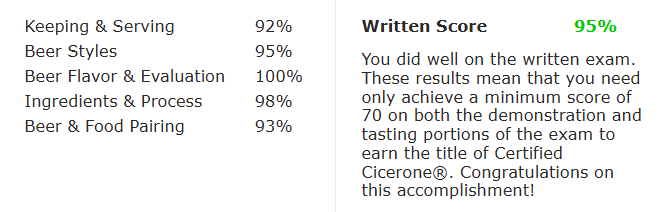
I risultati sono in linea con la mia preparazione. Voto pieno sulla teoria dei difetti, molto alto su ingredienti e processo, bene sugli stili, meno bene (ma comunque al di sopra del 90%) su servizio e abbinamenti.
Il Cicerone fornisce anche un dettaglio ulteriore sulle valutazioni per singola area, ma non aiuta molto. Sul servizio, ad esempio, il dettaglio si presenta così:
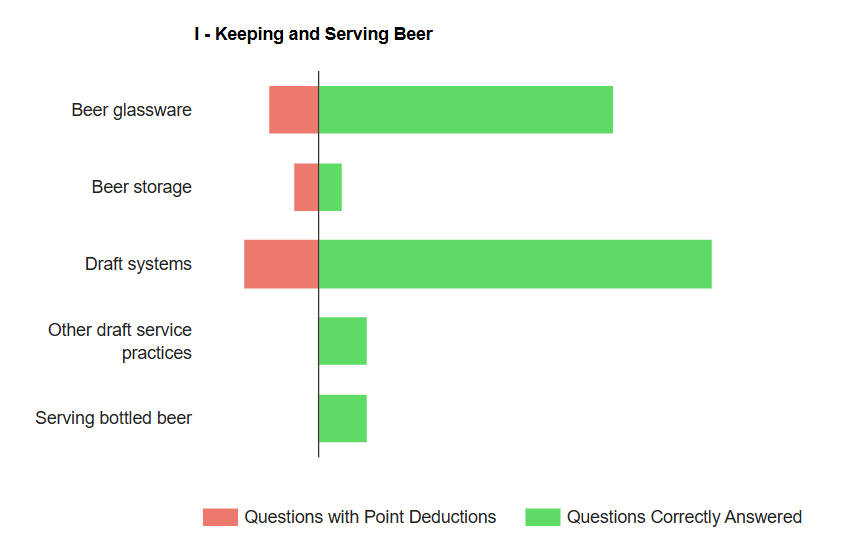
Il report non specifica il punteggio decurtato per singola sottosezione, permettendomi solo di dedurre che ho commesso i maggiori errori in ambito impianti, seguito da bicchieri (strano, sarà stata una distrazione) e conservazione della birra.
Considerando che si trattava del mio primo tentativo, posso ritenermi più che soddisfatto. Del resto il voto complessivo con cui si passa l’esame non riveste particolare importanza: il titolo che si ottiene rimane sempre quello di Certified Cicerone, a prescindere dal punteggio. Certo, passarlo con un buon voto resta comunque una soddisfazione personale.
Altri post sul Cicerone:
- Cos’è il Cicerone e in cosa è diverso dal BJCP
- Come funziona l’esame Tasting and Demo
- Impressioni a caldo sul mio esame Tasting and Demo

A practical guide to the Cicerone® Written Exam
After looking at how the Tasting & Demo Exam works, it’s time to talk about the heaviest part of the path to becoming a Certified Cicerone®: the Written Exam.
This is the test that weighs most on the final score, covering the entire Syllabus: service, styles, tasting, ingredients, production process, food pairing. Reading blogs and online discussion groups, it’s also the part of the exam most often described as an almost insurmountable obstacle.
Having taken it, my impression is different. It’s certainly a demanding exam, requiring broad and well organized preparation, but with the right method it’s decidedly manageable. In this post I’ll try to explain how it actually works: how to register, how it’s structured, what topics it covers, how I prepared for it.
How to access the Written Exam
This part of the exam can be taken online, registering for one of the sessions published on the Cicerone website. These are live sessions monitored remotely through a proctoring system.
Sessions run at set times; participants can potentially connect from anywhere in the world. Usually you register for the session most convenient for your time zone, but in theory you can join any of the available ones.
The cost is fairly high: $250 for the first attempt, $200 for subsequent ones. The only requirement is having passed the Certified Beer Server (CBS) exam.
This too is an online multiple choice test, but it can be taken at any time. Anyone with a basic knowledge of beer and its main off-lavors passes without particular trouble. The exam lasts 30 minutes, includes 60 multiple choice questions, and is passed by answering at least 45 correctly (75%). The cost is $79.
The Written Exam is available in two languages: English and Spanish. Non native speakers can request authorization to use an online translator during the exam. The request must be submitted beforehand, so Cicerone can pre approve the site that will be used for translation.
The infrastructure managing the exam is fairly strict. Throughout the test both the candidate’s face and the computer screen are recorded; any behavior deemed anomalous can lead to the exam being reviewed or invalidated. Candidates are also required to show and record an ID document.
How much the Written Exam weighs on the final score
As I explained in a previous post, the Certified Cicerone® is split into two exams. The two exams (green and light blue in the table below) can be taken in any order.
The Tasting & Demo Exam has relatively little impact on the final score, which is in fact determined almost entirely by the Written result. Unlike the Written, though, the Tasting requires a minimum score of 70% to pass.
There’s no minimum threshold required to pass the Written Exam. Still, doing the math, a score below 75% would make it mathematically impossible to reach the overall 80% required for certification.
How the Written Exam is structured
The Written Exam questions cover every topic in the Syllabus, split into five main areas. Each has a different weight on the final score and a different number of questions:
- Keeping and serving beer
- Beer Styles
- Beer Flavours and Evaluation
- Ingredients & Process
- Beer & Food Pairing
Beyond the classic multiple choice questions or those requiring a one or two word answer, the exam also includes three mini essays. The Beer & Food Pairing section also contains an open ended question: not multiple choice, but not as long as the mini essays either. The candidate can choose which of three proposed questions to answer.
Taking this breakdown into account, along with the weights shown in the table above and the structure of the sample exam published by Cicerone, we can reconstruct the Written Exam fairly accurately:
The exact number of questions can vary slightly from one session to another. Roughly speaking, though, you’re asked to answer 150 questions in 180 minutes. Of these, three are mini essays requiring answers of around 1000 to 2000 characters; one is an open ended question, placed in the Beer & Food Pairing section.
The area given the greatest weight is Beer Styles. Counting the dedicated mini essay too, it accounts for roughly 25% of the total Written Exam score. Beer Flavours and Evaluation weighs less on the written test; its contribution becomes much more important in the Tasting & Demo Exam, for obvious reasons.
If we assume about an hour is spent on the three mini essays (20 minutes each), that leaves 120 minutes for the other 150 questions. In practice, less than a minute per question.
That doesn’t sound like much. In reality, most questions are multiple choice or require a single word answer. With good preparation, many are solved in a few seconds; the time saved can go toward the harder ones or the topics you know less well.
The interface doesn’t allow free navigation back and forth between questions. It is possible, though, to flag an answer for review and come back to it later. The goal, naturally, is to reach the end of the three hours without leaving any unanswered. I have no idea how unanswered questions are scored.
When I took the exam I submitted about half an hour early. Not because I’m some kind of freak, simply because the time given is adequate if you arrive well prepared.
It remains a stressful exam, but personally I found it less demanding than the BJCP Written Exam, which lasts half as long. In the BJCP Written you have to write a huge amount in very little time; the Cicerone one, all things considered, leaves a bit more room to think, the pace is less hectic, and above all, you don’t have to handwrite your answers.
How to prepare for the Cicerone Written Exam
The primary source for figuring out what to study is, obviously, the Syllabus, available on the Cicerone website.
If you’re starting from zero, this is a genuinely demanding exam. There’s no single manual covering the whole program: you need to study from multiple sources. The one exception is the service section, covered almost entirely by the Draught Beer Quality Manual, published free by the Brewers Association and downloadable as a PDF.
For styles, you need to learn the BJCP guidelines inside out. They also include a short historical introduction for each style, more than enough for what the Cicerone Written Exam requires.
For ingredients and process, things are a bit more complex. For anyone starting from zero, I’d suggest a good homebrewing manual, like Fare La Birra In Casa, written by me and Angelo Ruggiero (available only in Italian), or How to Brew by John Palmer. Both also cover beer off-flavors in enough depth for the Written Exam.
In my case, I was starting from my BJCP Written Exam preparation. For the Cicerone, I focused almost exclusively on service, draught systems, and pairing. On the rest, I already had fairly solid preparation.
I studied pairing mainly from The Brewmaster’s Table by Garrett Oliver. Alternatively, you can get by reasonably well with various material available online.
Beer and food pairing is the topic I was (and still am) least prepared on; many answers, though, can be worked out with a bit of reasoning, once you understand the main pairing criteria (spiler: Saisons pairs well with everything!). Also, performance in this area weighs relatively little on the final score. You can get half the questions in this section wrong and still pass without particular trouble, as long as you’re strong on the rest.
There are also official Cicerone courses and paid materials called BeerSavvy®. I didn’t use them, but people who did have spoken very highly of the experience. Personally I don’t consider them essential: with the free material available online and a couple of good books, you’ll have all that you need.
The Written Exam isn’t easy, but it isn’t impossible either. After all, it’s only the second level of a path with four. I’d say the difficulty level is appropriate.
From a practical standpoint, there are several ways to practice for the written exam. If you don’t want to use the official paid Cicerone materials, there are various alternatives online. For example, I found this series of Cicerone-style questions, complete with correct answers. Some answers seem incorrect to me, but the positive aspect is that most of them can be easily verified using style manuals or other sources.
I also found it very helpful to use artificial intelligence to prepare for the exam. I provided the Cicerone sample test and various sources as input—such as the BJCP guidelines and my own slides on off-flavors—to set the context. I then asked the AI to generate a mock Written Exam with multiple-choice questions. You can start with specific subsections rather than diving straight into 150 questions.
I then had the AI grade my answers and provide what it considered to be the correct ones. Of course, you shouldn’t take its answers as gospel, but generally speaking, if you prime it well, the AI is quite accurate.
I also used the AI to practice writing mini-essays. I would ask it to give me a prompt on one of the exam topics, I’d write a response in English, and then have the AI grade my work as if it were a real Cicerone exam. I received some very useful feedback and suggestions; it was a great exercise for calibrating my writing length and pacing. It isn’t difficult to set up a Cicerone project in Claude AI to refine both the practice questions and the feedback
How my exam went
When I took the Cicerone Written Exam, in late August 2025, I was fairly confident about passing. After months of studying for the BJCP Written Exam, I had a solid base of knowledge, which I then supplemented with material on beer and food pairing, draught system management, and dispensing.
The exam went well, beyond my expectations: I came out with a solid 95/100. The report Cicerone sends isn’t very detailed, but you can draw some conclusions about where I did well and where I struggled a bit.
The results are in line with my preparation. Full marks on off-flavor theory, very high on ingredients and process, good on styles, less good (but still above 90%) on service and pairing.
Cicerone also provides some further detail on scores by area, but it doesn’t help much. On service, for example, the detail looks like this:
The report doesn’t specify the points lost per subsection, only letting me infer that I made the most mistakes on draught systems, followed by glassware (odd, must have been a lapse) and beer storage.
Considering this was my first attempt, I can call myself more than satisfied. After all, the overall score you pass with doesn’t really matter much: the title you earn is always Certified Cicerone, regardless of the score. Of course, passing with a good score is still a personal satisfaction.
Other posts about the Cicerone exam: