


Today, the worldwide network of active BJCP beer judges has reached 6,905 members (as of May 2026). A significant and growing portion of this community lives in the EMEA region, which now counts 884 active judges, representing about 13% of the global community across Europe, Africa, and the Middle East.
The community has grown substantially in recent years, but the growth has been anything but uniform, and the numbers behind the headline tell a more interesting story.
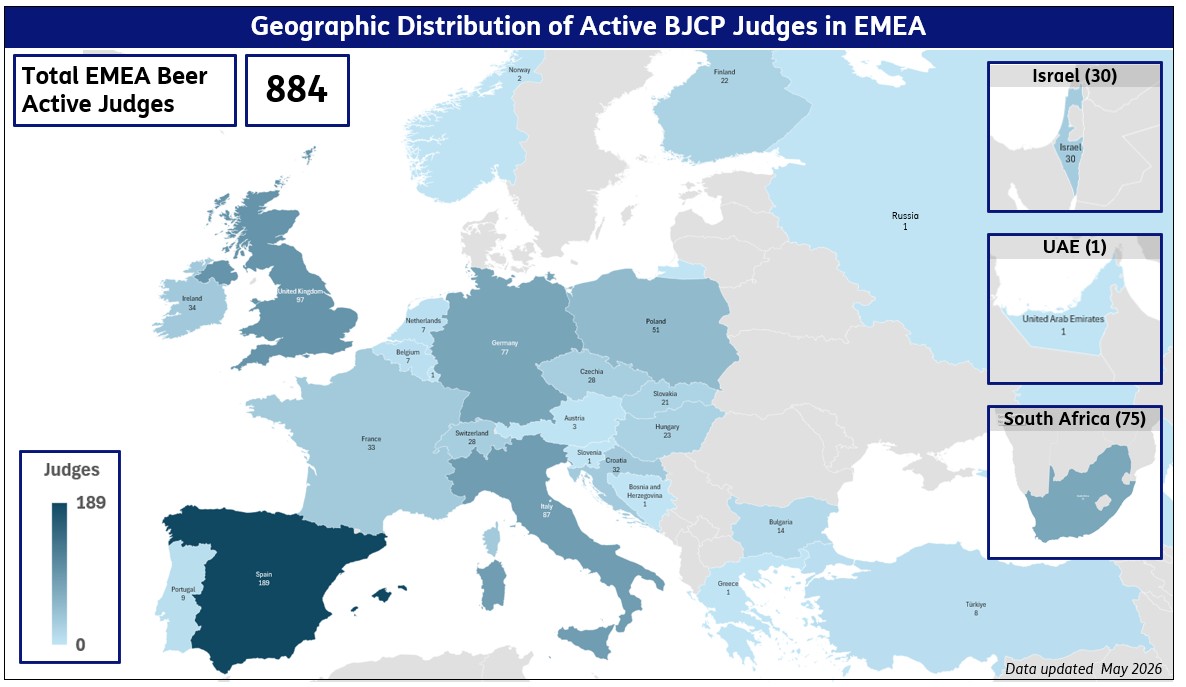
The data from the map below gives us a vivid picture of our community. As the dark shading immediately shows, Spain firmly leads the region with an impressive 189 active judges. Right behind, we find a tightly packed core group driving the movement in Europe, where the United Kingdom (97), Italy (87), and Germany (77) stand out as the established strongholds of the EMEA region.
Outside of Europe, it is also highly encouraging to see a strong and vibrant presence in countries like South Africa (75) and Israel (30), both of which boast a remarkable number of active judges.
However, the map also tells a story of uneven distribution. A closer look reveals several vast geographical areas with zero active judges, stretching from Eastern Europe to Scandinavia. These countries, highlighted in grey on the map, still offer a significant margin of growth for the European component of the EMEA region.
Size isn’t everything
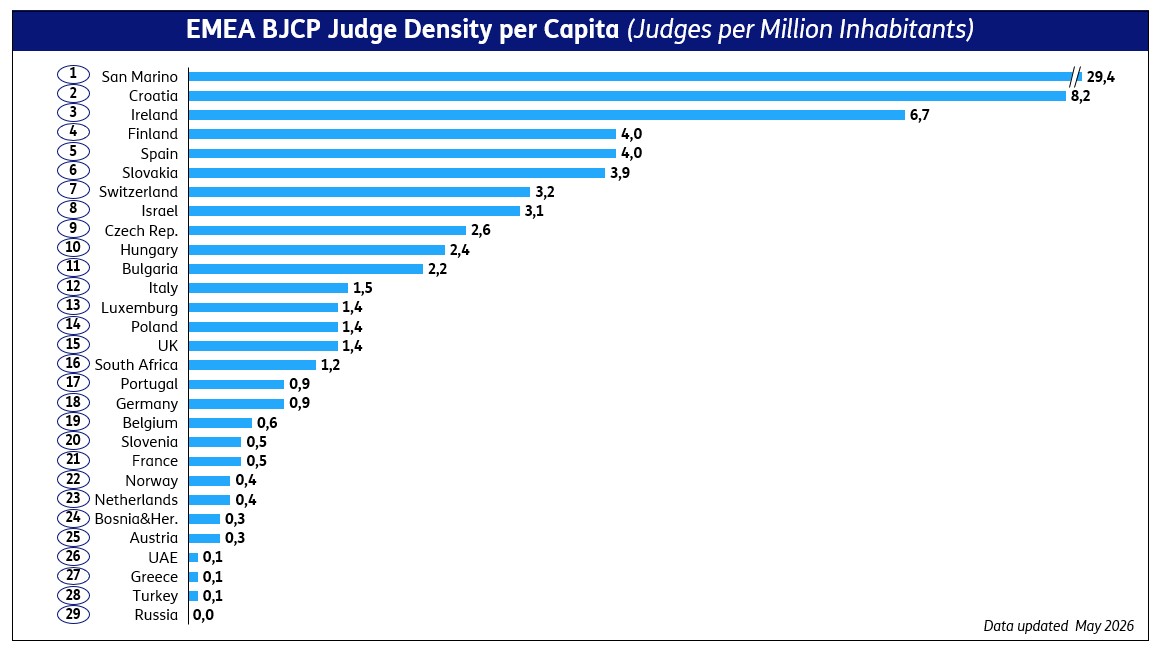
Spain remains the dominant force in absolute terms, with nearly twice the judges of the second-placed UK. But raw numbers only tell part of the story. When you adjust for population, the picture shifts dramatically: Croatia, despite being a relatively recent entrant to the BJCP world, ranks second in the entire region with 8.2 judges per million inhabitants, behind only the statistical outlier of San Marino (which remains a geographical exception, being a nation within Italy roughly the size of a municipality).
Ireland ranks third in judge density with 6.7 judges per million inhabitants, yet has no National-ranked judges. Fortunately, its proximity to the UK, whose National community has grown by three new judges in recent months, means external support is relatively accessible. Still, building local ranking depth remains the natural next step for the Irish community.
Who is catching up
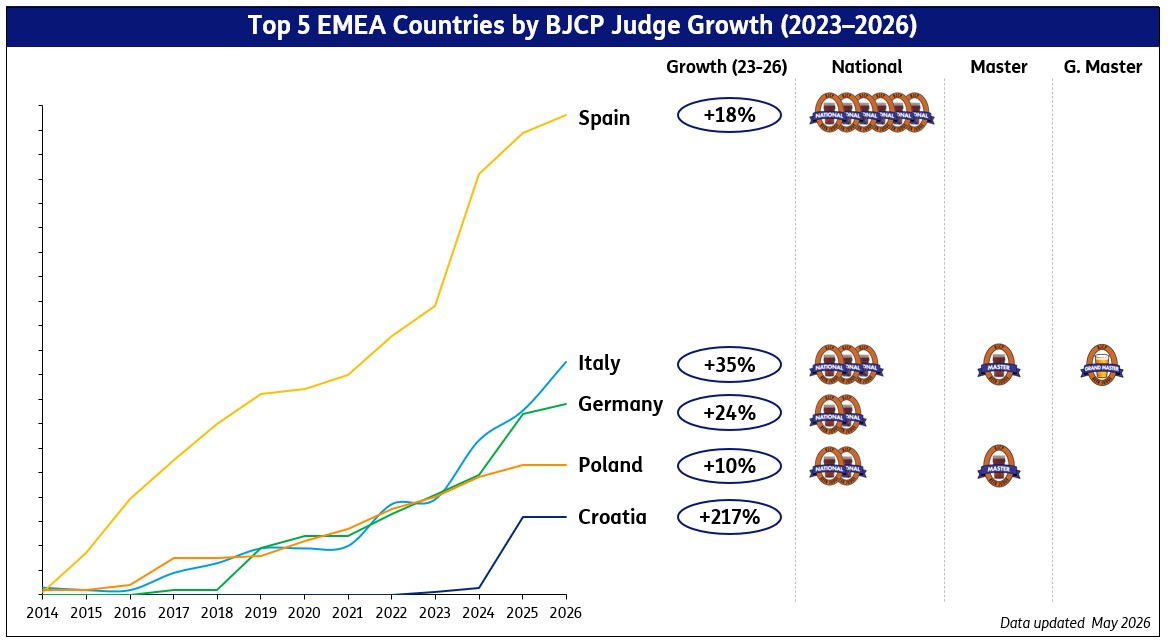
Among the EMEA nations, Spain, Italy, Germany, Poland, and Croatia experienced the highest growth in terms of judges between 2023 and 2026
Croatia’s ranking reflects the most explosive growth story in EMEA over the past three years. A 217% increase since 2023 is not a gradual trend; it is a community that essentially built itself from scratch in a very short time. I remember it like it was yesterday when, together with Frank Christian, we went right to Split, Croatia, to proctor a BJCP exam organized by Hirendu Vaishnav (who came all the way from California!)
Italy (+35%) and Germany (+24%) are the standout performers among the larger countries, while Spain continues to grow despite already being the biggest community in the region.
Currently, Spain has the highest number of National or higher-ranked judges in EMEA (6), followed by Italy (5) and Israel (5).
Beyond the numbers: exam self-sufficiency
Growth in raw numbers is only one dimension of a community’s maturity. A critical operational milestone for any national judge community is the ability to run Tasting Exams independently, without relying on external support. This requires at least three judges at National rank or above. With two National+ judges a community can manage a Tasting Exam, provided the exam administrator role is covered by a Certified judge under a waiver, but it remains more difficult.
Notably, Israel and Italy hold the unique distinction of harboring the only two Grand Master judges in the entire EMEA region (Omer Basha and me).
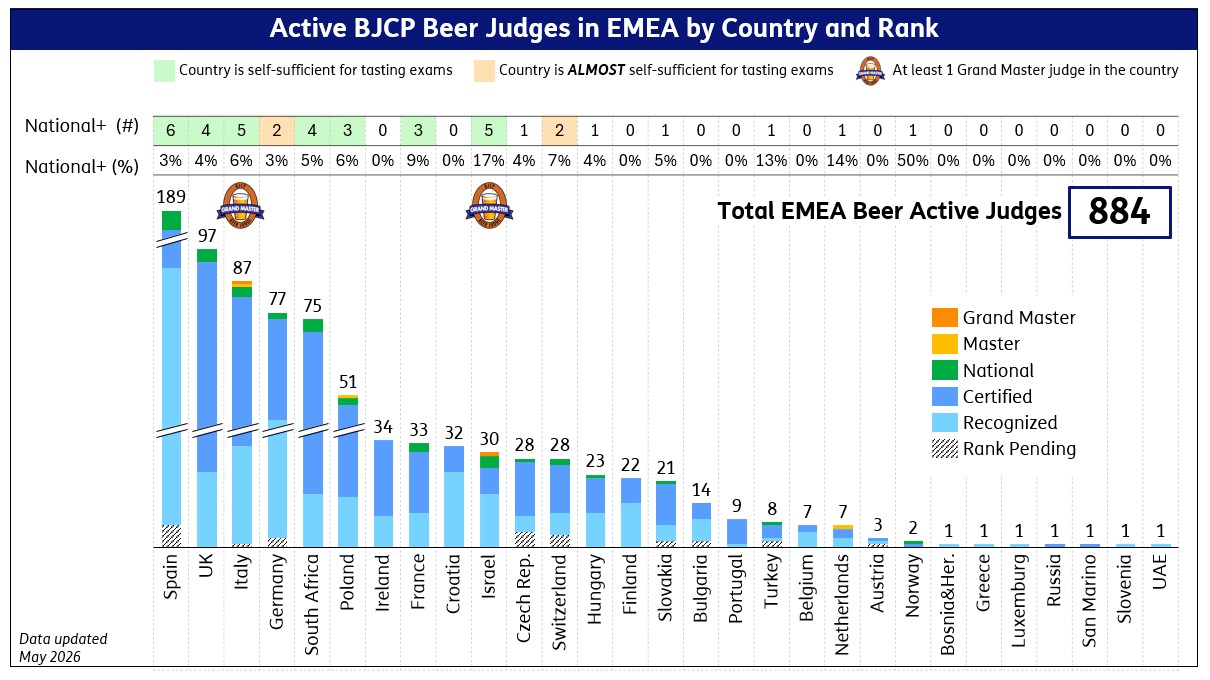
Several countries have comfortably crossed this threshold: Spain, the UK, South Africa, Israel, Italy, Poland, and France all qualify. Others are close but not quite there.
Germany, for instance, is the fourth-largest community in EMEA with 77 judges, yet sits at just two National-ranked judges, right on the edge.
Croatia’s extraordinary growth, meanwhile, has not yet produced judges at the upper ranks: with zero National+ judges, the community still depends on external support to run its own exams, which is the next natural challenge for a scene that has grown so fast.
What’s next?
Raw numbers alone, however, don’t tell the whole story. Mapping National and higher-ranked judges and understanding who is willing to travel to proctor exams and offer mentorship is the only way to design a concrete, region-wide action plan for self-sufficiency.
But there is a subtler challenge that the data does not capture directly: across EMEA, a growing number of judges pass the Tasting Exam and stop there. They count toward our headline numbers, yet their practical contribution to the community remains limited. This is not a criticism; it reflects a lack of structured support and encouragement to go further.
Expanding the base of Recognized and Certified judges is a worthwhile goal, but it cannot be the finish line. Advancing beyond Certified means committing to serious study, and that investment shows: higher-ranked judges evaluate more accurately, give more useful feedback, and raise the overall standard of every competition they participate in. A community that grows upward, not just outward, is a community that genuinely improves.

The tools to do this exist and are not complicated: online preparation sessions, shared study resources, practical guidance on both the tasting and written exams. On this blog, the BJCP section (with most posts in English) has grown over the years into a collection of resources aimed at helping judges study smarter and perform better, on both the written and tasting sides of the exam.
The numbers are promising, but they are just the starting point. Growing the base of judges across EMEA is a worthy goal, and the region has done it well. But horizontal growth alone is not enough.
The next chapter will need an equally strong push in the other direction: more judges choosing to keep studying, advancing through the ranks, and building the kind of deep expertise that makes a community truly self-sufficient. Vertical growth also means better judging, and from my practical experience, that is something competitions across the region need. On that front, there is still plenty of room to grow.

Aggiornamento dei numeri EMEA e idee per crescere
La comunità globale dei giudici BJCP ha raggiunto 6.905 membri attivi (dato aggiornato a maggio 2026). Una fetta significativa e in crescita dei giudici è rappresentata dalla regione EMEA, che conta oggi 884 giudici attivi, pari a circa il 13% del totale, distribuiti tra Europa, Africa e Medio Oriente.
La crescita degli ultimi anni è stata sostanziale, ma tutt’altro che uniforme. I numeri dietro al dato aggregato raccontano una storia molto più interessante.
La mappa qui sotto fornisce un’immagine a colpo d”occhio della nostra comunità. La Spagna domina l’EMEA con 189 giudici attivi, un numero davvero impressionante. Subito dietro troviamo tre nazioni che trainano il movimento in Europa: il Regno Unito (97), l’Italia (87) e la Germania (77) sono le realtà più consolidate dell’EMEA.
Fuori dall’Europa, è incoraggiante vedere una presenza solida in paesi come il Sudafrica (75) e Israele (30), entrambi con numeri di tutto rispetto.
La mappa, però, evidenzia anche una distribuzione disomogenea. Guardando con attenzione, balzano all’occhio intere aree geografiche senza nemmeno un giudice attivo, come la Scandinavia o buona parte dell’Europa Orientale. Queste nazioni, evidenziate in grigio, rappresentano un margine di crescita ancora tutto da esplorare per la componente europea dell’EMEA.
Le dimensioni non sono tutto
La Spagna rimane la forza dominante in termini assoluti, con quasi il doppio dei giudici rispetto al Regno Unito, che si posiziona secondo per numero dei giudici. Ma i numeri grezzi raccontano solo una parte della storia.
Normalizzando per popolazione, il quadro cambia radicalmente: la Croazia, pur essendo una realtà relativamente recente nel mondo BJCP, si piazza seconda nell’intera regione con 8,2 giudici per milione di abitanti, dietro soltanto a San Marino (che resta un’eccezione geografica, essendo una nazione all’interno dell’Italia grande quanto un comune).
L’Irlanda si posiziona terza nella classifica della densità di giudici con 6,7 giudici per milione di abitanti, pur non avendo ancora nessun giudice di rank National. La vicinanza al Regno Unito, la cui comunità di National è cresciuta di ben tre nuovi giudici negli ultimi mesi, rende il supporto esterno relativamente accessibile. Detto questo, arrivare ad avere National nazionali rimane il prossimo passo naturale per la comunità irlandese.
Chi sta crescendo maggiormemente
Tra le nazioni EMEA, Spagna, Italia, Germania, Polonia e Croazia hanno registrato la crescita più alta in termini di giudici tra il 2023 e il 2026.
La Croazia racconta la storia di crescita più esplosiva dell’intera regione negli ultimi tre anni. Un aumento del 217% dei giudici negli ultimi tre anni evidenzia comunità che si è costruita praticamente dal nulla in pochissimo tempo. Ricordo bene quando, insieme a Frank Christian, siamo andati a Spalato per fare i proctor a un esame BJCP organizzato da Hirendu Vaishnav, che era venuto apposta dalla California.
Italia (+35%) e Germania (+24%) hanno avuto la crescita maggiore tra le nazioni più popolate, mentre la Spagna continua a crescere nonostante sia già la comunità più numerosa della regione.
Attualmente, la Spagna ha il maggior numero di giudici di rank National o superiore nell’EMEA (6), seguita da Italia (5) e Israele (5).
Oltre i numeri: l’autosufficienza negli esami
La crescita numerica è solo una dimensione della maturità di una comunità. Un traguardo operativo fondamentale per qualsiasi comunità nazionale è la capacità di organizzare i Tasting Exam in autonomia, senza dipendere da supporto esterno. Questo richiede almeno tre giudici di rank National o superiore. Anche con due soli giudici National+ è possibile gestire un Tasting Exam, a condizione che il ruolo di exam administrator sia coperto da un giudice Certified con deroga, ma la situazione resta più difficile da gestire.
Vale la pena sottolineare che Israele e Italia possono vantare un primato unico: sono gli unici due paesi dell’intera regione EMEA ad avere un giudice Grand Master (Omer Basha e il sottoscritto).
Diversi paesi hanno già superato la soglia dell’autosufficienza: Spagna, Regno Unito, Sudafrica, Israele, Italia, Polonia e Francia. Altri ci sono vicini ma non ancora del tutto.
La Germania, per esempio, è la quarta comunità dell’EMEA per dimensioni con 77 giudici, ma conta solo due giudici National: è proprio lì sul limite.
La Croazia, con la sua crescita straordinaria, non ha ancora prodotto giudici di rank elevato: senza giudici National+, la comunità dipende ancora da supporto esterno per organizzare i propri esami. La crescita nel rank dei propri giudici è la prossima sfida naturale per una scena che ha avuto una crescita repentina.
E adesso?
I numeri da soli, però, non bastano. Mappare i giudici National e di rank superiore, capire chi è disponibile a viaggiare per fare da proctor ai Tasting Exam (non tutti i National+ lo sono) e fare mentoring sono le cose da fare per costruire un piano d’azione concreto e su scala regionale che stimoli ogni nazione alla crescita sia verticale (rank) sia orizzontale (base dei giudici).
C’è però una sfida più sottile, che i dati non catturano direttamente: nell’EMEA, un numero crescente di giudici supera il Tasting Exam e si ferma lì. Entrano nelle statistiche, ma il loro contributo pratico alla comunità resta limitato. Non è una critica: è il segnale che mancano supporto strutturato e stimolo a fare di più.
Ampliare la base dei giudici Recognized e Certified è un obiettivo valido, ma non può essere il traguardo finale. Avanzare oltre il rank di Certified significa studiare, e questo si vede: i giudici di rank più elevato valutano con maggiore precisione, forniscono feedback più utili e alzano il livello complessivo di ogni giuria a cui partecipano. Una comunità che cresce in verticale, non solo in orizzontale, è una comunità che migliora in qualità.
Gli strumenti per farlo esistono: sessioni di preparazione online, materiale di studio condiviso, indicazioni pratiche per Tasting e Written Exam. Su questo blog, la sezione BJCP (con la maggior parte dei post in inglese) è cresciuta nel tempo fino a diventare una raccolta di risorse pensate per aiutare i giudici a studiare meglio e a prepararsi in modo più efficace.
I numeri EMEA sono promettenti, ma rappresentano solo il punto di partenza. Espandere la base dei giudici nell’EMEA è un obiettivo valido che dobbiamo continuare a perseguire. Ma la crescita orizzontale da sola non basta.
Il prossimo capitolo richiederà una spinta altrettanto forte nella direzione verticale: più giudici che scelgono di continuare a studiare, di avanzare di rank, di costruire competenza. Crescita verticale si traduce in giurie migliori, e per esperienza diretta questo è qualcosa di cui le competizioni della regione hanno concretamente bisogno. Su questo fronte, il margine di crescita è ancora ampio.