
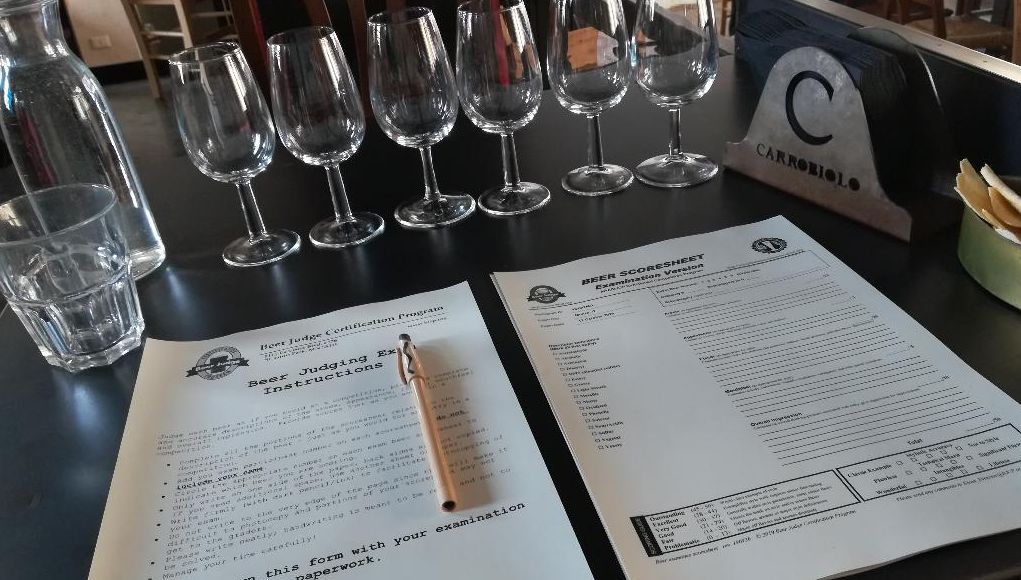

The BJCP (Beer Judge Certification Program) is an American organization founded in 1985. The main goal of the association is to promote the appreciation of beer, cider, and mead. In this guide, I’ll cover the beer side of the program.
I am a Grand Master BJCP judge based in Rome (Italy) who joined the program in 2017. I also serve as a Lead Grader (which means I grade BJCP exams) and as an Exam Administrator here in Italy.
The BJCP primarily focuses on developing and providing standardized tools for the structured evaluation of beer. The evaluation is based on style parameters codified by the BJCP guidelines, which are published and updated periodically. In BJCP competitions around the world, as well as in other contests, BJCP Scoresheets are used to evaluate beer.
BJCP competitions are open to all judges, not only those certified by the BJCP. They can be competitions for homebrewed beers as well as contests aimed at professional brewers. Being a BJCP judge does not guarantee being invited to judge at BJCP competitions, but it can be considered an added value, especially at the higher certification levels, which attest to greater knowledge and experience.
BJCP judge ranks (listed in order of achievement):
- Provisional
- Recognized
- Certified
- National
- Master
- Grand Master ← I am here
There is also another rank: Apprentice. This is a temporary rank. It is assigned to those who attempt the Tasting Exam but fail. The candidate has two years to retake the exam; otherwise, they lose the Apprentice rank and become Affiliated.
Affiliated is a status, not a rank. It means that the person is no longer considered a BJCP member but retains their ID in case they later pass an Entrance Exam and then the Tasting Exam.
BJCP exams (listed in order of feasibility):
- BJCP Judge Entrance Exam (online exam)
- BJCP Judging exam (tasting exam) ← My best score: 91/100
- BJCP Written Proficiency Exam (written exam) ← My score: 93/100
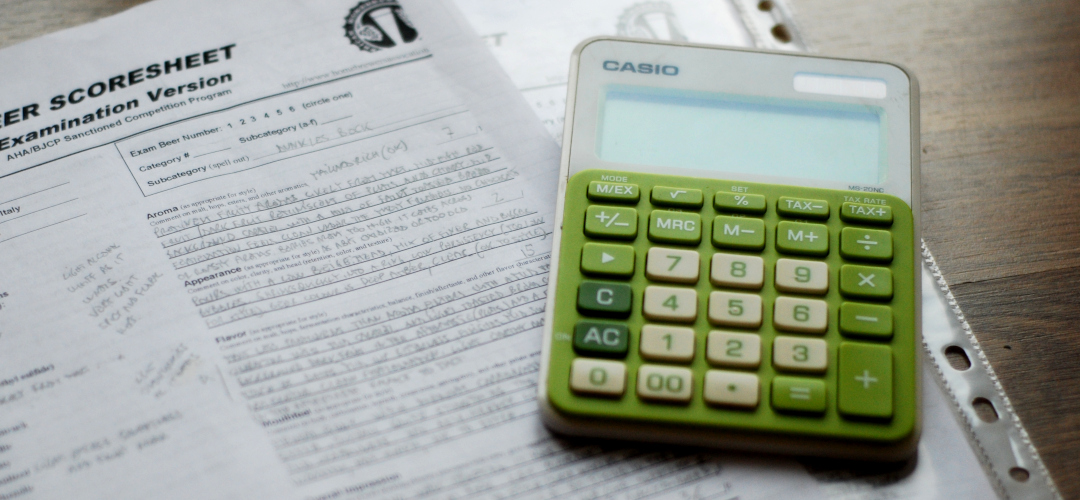
BJCP exams
To join the BJCP and advance within its ranking system, candidates must pass a series of exams. The first is an Online Exam, which is fairly easy. It is a pass/fail exam, with no score given.
The second is a Tasting Exam, held in-person. This exam is fairly easy to pass, but achieving a high score is not easy. A minimum score of 60/100 is required to pass.
The third is a Written Exam, also taken in-person. Aside from a very brief initial section with T/F questions, the rest consists of short essays that require significant effort. The passing score is 60/100. This is the final BJCP exam and is quite challenging.
BJCP Beer Judge Entrance Exam (Online Exam)
The BJCP Beer Judge Entrance Exam is an online exam that consists of 180 multiple-choice questions to be answered in 60 minutes. Non-native English speakers may request an extension to 90 minutes.
The exam is not particularly difficult. With some general knowledge about beer and beer styles, is feasible.
There is no verification system to ensure that the person taking the exam is actually the registered candidate, nor are there checks on the browser windows that may be consulted during the exam.
This is not an encouragement to cheat, of course, but with 90 minutes available for non-native speakers, there is enough time to look up the more difficult answers online. And I imagine there may be people around the world who take the online exam on behalf of others. Other exams, such as the Cicerone, have stricter identity checks and enforce measures to prevent candidates from looking up answers online during the exam.
Let’s say this exam exists mainly to prevent just anyone from moving on to the next step, which is the BJCP Judging Exam.
Here you can find all the details on the topics covered in the online exam. Here you can register for the exam for $10. There is also the option to try a free test with 20 questions.
Once the online exam is passed, the candidate receives the title of Provisional Judge. At this stage, one does not yet receive a BJCP ID number nor access to the members’ area of the BJCP website, but experience points earned by participating in BJCP competitions as a Provisional judge are recorded using the email address as an ID.
The experience points will become visible on the BJCP website once the Tasting Exam has been taken and a BJCP ID number has been assigned.
Once the online exam has been passed, there are two years available to attempt the Tasting Exam. Otherwise, the online exam must be taken again.
BJCP Judging Exam (in-person Tasting Exam)
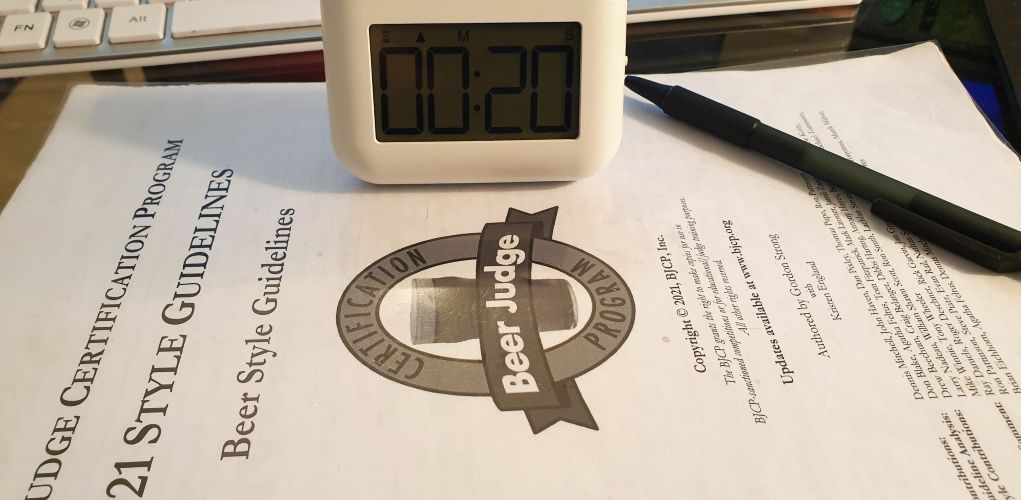
The BJCP judging exam consists of a blind tasting and evaluation of six beers using the BJCP Scoresheets. The exam lasts one and a half hours and takes place in-person. Multiple exam sessions are organized worldwide by BJCP judges. The schedule is available here. Seats are generally limited to 12. Outside the U.S., exams are not that frequent, so it’s best to register well in advance. The cost of the exam is 40$.
The evaluation of the exam beers is made against the BJCP Style guidelines. It is a closed book exam.
Scoresheets are usually filled out in English. In some cases, administrators allow candidates to take the exam in another language. The scoresheets are typically translated into English and graded, since only in a few cases is there a grading chain (which requires several judges of different levels) in languages other than English.
Exams are graded based on the scoresheets filled in by two or three proctors. Proctors are experienced judges who fill out the scoresheets blindly, in exactly the same way as the candidates. Grading usually takes three to six months, with translation adding a few extra months.
Passing the exam is fairly straightforward. I know only one person who hasn’t passed it (in this case, they got assigned the Apprentice rank). As a grader, I’ve evaluated several candidates with very low-level skills, but because of how the scoring system is structured, it’s really difficult to assign a failing score.
In my opinion, this is an aspect that could be improved. There are, in fact, too many BJCP judges around the world who stop at the basic level (Recognized), settling for a very low score. This can sometimes undermine the value of the BJCP certification, especially in the eyes of those who have no idea about the ranks and how progression between them works.
Let’s say that 70 is considered a fair score. A good starting point to get some solid experience. An 80 is good and usually indicates solid knowledge about beer and well-prepared scoresheets. Of course, BJCP ranks and scores are not the only way to assess a judge’s quality and experience, but they provide a useful benchmark.
Here are some links to previous posts where I share more about the Tasting Exam:
- My first ever BJCP Tasting Exam
- BJCP: study tools
- Master Level BJCP Tasting Exam Scoresheets (Francesco Antonelli)
- A grader’s view on the most frequent mistakes in BJCP exam scoresheets
The highest rank achievable with the written exam is Certified. To go beyond this, it is necessary to take the Written Exam.
BJCP Written Proficiency Exam (in-person Written Exam)
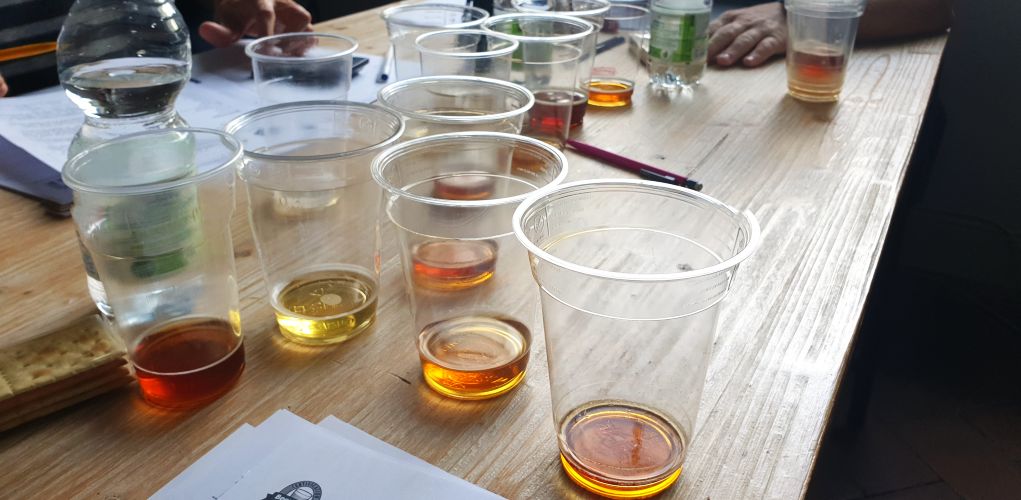
This is the most advanced exam in the BJCP pathway. No beers are tasted; this exam is entirely based on theoretical knowledge. It lasts an hour and a half and covers styles, recipes, faults, ingredients, and the brewing process.
The cost of the exam is 25$.
Some detailed posts about the Written Exam that I wrote in the past:
- My thoughts about the Written Exam
- My Written Exam
- BJCP Written Exam / General Advice and T-F Questions
- BJCP Written Exam / How to answer the Styles Question
- BJCP Written Exam / How to answer the Recipe Question
The Written Exam can only be taken if a candidate has scored 80 or higher on the Tasting Exam and has earned at least 10 experience points from judging. If the average score between the Tasting and Written Exams is 80 or higher, and the candidate has accumulated 20 experience points (at least 10 from judging), a National rank is awarded.
What judges at the National level and above can do:
- Serve as proctors for exams (in some cases with travel reimbursement)
- Organize exams (more on that here)
- Volunteer as graders and score exams (more on that here)
To reach the Master level, the average score between the Tasting and Written Exams must be 90 or higher.
The Written Exam is challenging. It requires extensive theoretical knowledge and a good amount of memorization regarding beer styles. Scoring an 80 on this exam is not easy; achieving a 90 is very difficult. Written Exams are not frequently scheduled, and often candidates need to travel to take one (especially in Europe, where they are held regularly only in Spain).
However, it is possible to ask a National or Master-level judge to organize one. Unlike the Tasting Exam, the Written Exam organization is quite straightforward. If there are no travel costs and the proposed date aligns with the quarters when Written Exams are held worldwide, the exam will likely be approved.
How the BJCP ranking works
The BJCP is based on a ranking system composed of six levels.
The Apprentice level is assigned to those who do not pass the Tasting Exam (score <60/100). Of course, the exam can be retaken. The Provisional level is assigned once the online exam is passed. The other four levels that can be reached through exams are Recognized, Certified, National, and Master. Advancement between these 4 ranks is based on exam scores and experience points.
Part of the experience points (Judging Points) are earned by serving as a judge in BJCP-sanctioned competitions. Judges can earn on average between 1 and 2 points per panel.
Additional points (non-judging points) can be earned by organizing or grading exams, serving as stewards in competitions, or taking on active roles within the BJCP organization (the latter is less common).
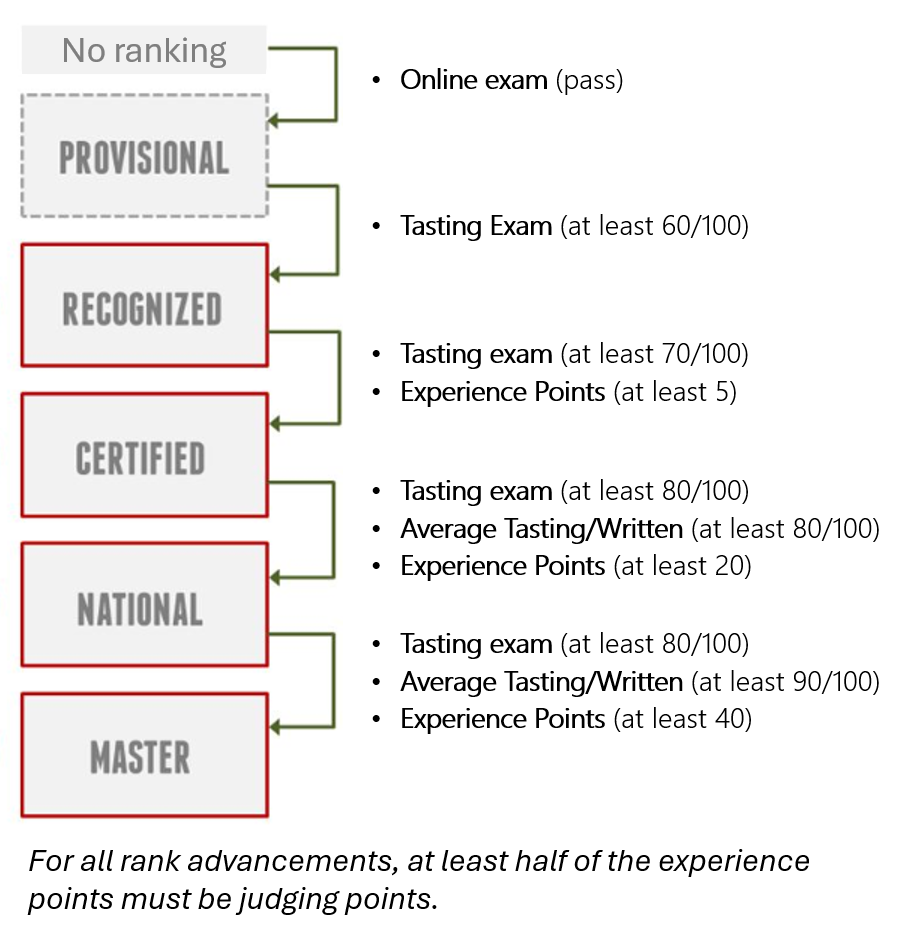
The final level is Grand Master. To advance from Master to Grand Master, no additional exams are required. Candidates need 100 experience points (at least 50 of which must be Judging Points) and 240 GMSR (Grand Master Service Requirements).
GMSR are earned through active participation in BJCP activities. For example, organizing an exam grants 10 GMSR. A grader who grades an exam with 12 participants earns 12 GMSR. A Lead Grader (a more experienced grader) earns double. There are other ways to earn GMSR points (details here).
To become Grand Master II, an additional 100 experience + 240 GMSR are required. And so on for Grand Master III, IV, V, …
Starting at the end of 2024, the Distinguished Certified e Distinguished National ranks were introduced to recognize the experience and dedication of BJCP judges who have not advanced through exams but have been active members of the BJCP for at least 15 years, with 40+ or 60+ experience points, respectively (here for details).
BJCP judge database and rankings
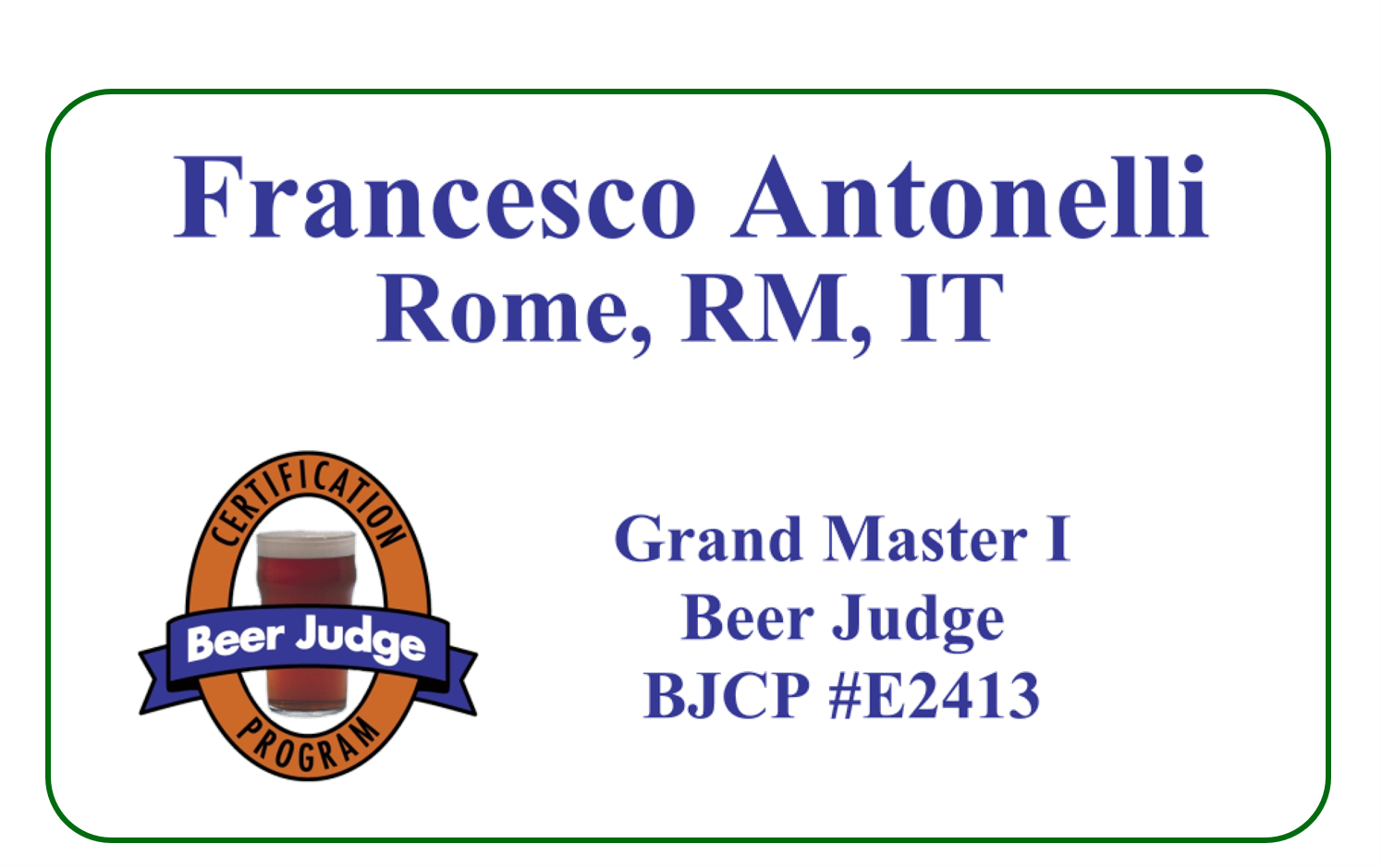
The BJCP provides an online judge database where active members can be verified by searching for either a BJCP ID or a judge’s first and last name.
A public list of pre-authorized exam proctors is also available. It includes judges eligible to proctor exams and displays their current rank, although ranks are shown only for judges at the National level and above.

BJCP: guida completa a esami, livelli e funzionamento del programma
Il BJCP (Beer Judge Certification Program) è un’organizzazione americana fondata nel 1985. L’obiettivo principale dell’associazione è promuovere l’apprezzamento della birra, del sidro e dell’idromele. In questa guida parlerò solo della parte dedicata alla birra.
Sono un giudice Grand Master BJCP con base a Roma, entrato nel programma nel 2017. Ricopro anche il ruolo di Lead Grader (correggo gli esami BJCP) e di Exam Administrator, per gli esami che organizzo qui in Italia (non sono l’unico in Italia a organizzare esami BJCP).
Il BJCP si concentra principalmente sullo sviluppo e sulla condivisione di strumenti standardizzati per la valutazione strutturata della birra. La valutazione si basa sui parametri di stile codificati dalle linee guida BJCP, pubblicate e aggiornate periodicamente. Nelle competizioni BJCP in tutto il mondo, così come in altri concorsi, si utilizzano gli Scoresheet BJCP per valutare la birra. Di seguito i link ufficiali:
Le competizioni BJCP sono aperte a tutti i giudici, non solo a quelli certificati dal BJCP. Possono essere competizioni per birre homebrewed così come concorsi rivolti a birrai professionisti. Essere un giudice BJCP non garantisce di essere invitato a giudicare alle competizioni BJCP, ma può essere considerato un valore aggiunto, soprattutto ai livelli di certificazione più alti, che attestano una maggiore conoscenza ed esperienza.
Livelli dei giudici BJCP (elencati in ordine di conseguimento):
- Provisional
- Recognized
- Certified
- National
- Master
- Grand Master ← Io sono qui
Esiste anche un altro livello chiamato Apprentice. Si tratta di un livello temporaneo. Viene assegnato a chi tenta il Tasting Exam senza superarlo. Il candidato ha due anni di tempo per ripetere l’esame, altrimenti perde il livello di Apprentice e diventa Affiliated.
Affiliated è uno status, non un livello. Significa che la persona non è più considerata membro BJCP, ma mantiene il proprio ID nel caso in cui in seguito superi un Entrance Exam e poi il Tasting Exam.
Esami BJCP (elencati in ordine di sostenibilità):
- BJCP Judge Entrance Exam (online exam)
- BJCP Judging exam (tasting exam) ← Il mio miglior punteggio: 91/100
- BJCP Written Proficiency Exam (written exam) ← Il mio miglior punteggio: 93/100
Gli esami BJCP
Per entrare nel BJCP e avanzare nel suo sistema di livelli, i candidati devono superare una serie di esami. Il primo è l’Entrance Exam ed piuttosto semplice. È un esame pass/fail, senza punteggio.
Il secondo è il Judging Exam (chiamato anche Tasting Exam), che si svolge in presenza. Superarlo è relativamente semplice, ottenere un punteggio alto molto meno. Per passare serve un punteggio minimo di 60/100.
Il terzo è il Written Proficiency Exam (spesso chiamato semplicemente Written Exam), anch’esso in presenza. A parte una breve sezione iniziale con domande V/F, il resto consiste in saggi brevi che richiedono un impegno notevole. Il punteggio per passare è 60/100. È l’ultimo esame BJCP ed è piuttosto impegnativo.
BJCP Beer Judge Entrance Exam (Online Exam)
Il BJCP Beer Judge Entrance Exam è un esame online composto da 180 domande a risposta multipla, da completare in 60 minuti. I madrelingua non inglesi possono richiedere un’estensione a 90 minuti.
L’esame non è particolarmente difficile. Con una conoscenza generale della birra e degli stili è affrontabile.
Non esiste un sistema di verifica che accerti che la persona che sostiene l’esame sia effettivamente il candidato registrato, né controlli sulle finestre del browser consultabili durante l’esame.
Questo non è un incoraggiamento a copiare, ovviamente, ma con 90 minuti a disposizione per i non madrelingua, c’è tutto il tempo per cercare online le risposte più difficili. Immagino anche che, in giro per il mondo, ci sia chi sostiene l’esame online al posto di qualcun altro. Altri esami, come il Cicerone, hanno controlli d’identità più rigidi e misure per impedire ai candidati di cercare le risposte online durante la prova.
Diciamo che questo esame esiste soprattutto per evitare che chiunque possa passare direttamente al passo successivo, il BJCP Judging Exam.
Qui tutti i dettagli sugli argomenti coperti dall’esame online. Qui ci si può iscrivere all’esame per 10$. C’è anche la possibilità di provare un test gratuito con 20 domande.
Superato l’esame online, il candidato riceve il titolo di Provisional Judge. In questa fase non si riceve ancora un numero identificativo BJCP né l’accesso all’area membri del sito BJCP, ma i punti esperienza guadagnati partecipando a competizioni BJCP come giudice Provisional vengono registrati usando l’indirizzo email come ID.
I punti esperienza diventeranno visibili sul sito BJCP unavolta sostenuto il Tasting Exam, quando sarà assegnato un ID BJCP.
Superato l’esame online, ci sono due anni di tempo per tentare il Tasting Exam. In caso contrario, l’esame online va ripetuto.
BJCP Judging Exam (Tasting Exam)
Il BJCP Judging Exam consiste nell’assaggio alla cieca di sei birre con compilazione degli Scoresheet BJCP. L’esame dura un’ora e mezza e si svolge in presenza. Nel mondo vengono organizzate diverse sessioni d’esame, il calendario è disponibile qui. I posti sono generalmente limitati a 12. Fuori dagli Stati Uniti gli esami non sono così frequenti, quindi conviene iscriversi con largo anticipo. Il costo dell’esame è 40$.
La valutazione delle birre d’esame avviene in base alle linee guida BJCP. Non si possono consultare le linee guida durante l’esame.
Gli scoresheet vengono solitamente compilati in inglese. In alcuni casi gli amministratori permettono ai candidati di sostenere l’esame in un’altra lingua. Gli scoresheet vengono di norma tradotti in inglese e corretti, dato che solo in pochi casi esiste una catena di correzione (che richiede diversi giudici di livello differente) in lingue diverse dall’inglese.
Gli esami vengono corretti confrontandoli con gli scoresheet compilati da due o tre proctor. I proctor sono giudici esperti che compilano gli scoresheet alla cieca, esattamente come i candidati. La correzione richiede solitamente dai tre ai sei mesi, con la traduzione che aggiunge qualche mese in più.
Superare l’esame è piuttosto semplice. Conosco solo una persona che non l’ha superato: in quel caso è stato assegnato il livello di Apprentice. Come grader ho valutato diversi candidati con competenze molto scarse, ma per come è strutturato il sistema di valutazione, è davvero difficile assegnare un punteggio che porti alla bocciatura. Diciamo le cose come stanno: questo esame lo passa più o meno chiunque.
A mio parere, questo è un aspetto migliorabile. Ci sono infatti troppi giudici BJCP nel mondo che si fermano al livello base (Recognized), accontentandosi di un punteggio molto basso. Questo a volte può svalutare la certificazione BJCP, soprattutto agli occhi di chi non ha idea di come funzionino i livelli e la progressione tra un livello e il successivo.
Diciamo che 70/100 è considerato un punteggio onesto. Un buon punto di partenza. 80/100 è un buon punteggio e di solito indica una buona conoscenza degli stili e una discreta padronanza nella compilazione degli scoresheet. Naturalmente livelli e punteggi BJCP non sono l’unico strumento per valutare la qualità e l’esperienza di un giudice, ma costituiscono un primo parametro di riferimento.
Ecco alcuni link a post precedenti dove racconto qualcosa in più sul Tasting Exam:
- My Il mio primo BJCP Tasting Exam
- BJCP: risorse per studiare
- Master Level BJCP Tasting Exam Scoresheets
- A grader’s view on the most frequent mistakes in BJCP exam scoresheets
Il livello massimo raggiungibile fermandosi al Tasting Exam è Certified. Per andare oltre, è necessario sostenere il Written Exam.
BJCP Written Proficiency Exam (Written Exam)
Questo è l’esame più avanzato nel percorso BJCP. Non si degustano birre: l’esame si basa interamente sulla conoscenza teorica. Dura un’ora e mezza e copre stili, ricette, difetti, ingredienti e processo di produzione.
Il costo dell’esame è 25$.
Alcuni post dettagliati sul Written Exam che ho scritto in passato:
- My thoughts about the Written Exam
- My Written Exam
- BJCP Written Exam / General Advice and T-F Questions
- BJCP Written Exam / How to answer the Styles Question
- BJCP Written Exam / How to answer the Recipe Question
Il Written Exam può essere sostenuto solo se il candidato ha ottenuto un punteggio di 80 o superiore al Tasting Exam e ha maturato almeno 10 punti esperienza come giudice. Con una media di almeno 80 tra i punteggi del Tasting e del Written Exam, e con un almeno 20 punti esperienza (di cui almeno 10 come giudice), si arriva al livello National.
Cosa possono fare i giudici di livello National e superiore:
- fare da proctor agli esami (in alcuni casi con rimborso delle spese di viaggio)
- organizzare esami (maggiori dettagli qui)
- proporsi come grader e correggere esami (maggiori dettagli qui)
Per raggiungere il livello Master, la media tra i punteggi del Tasting e del Written Exam deve essere pari o superiore a 90.
Il Written Exam è impegnativo. Richiede una conoscenza teorica approfondita e una buona dose di memorizzazione degli stili birrari. Ottenere un 80 non è facile; arrivare a 90 è molto difficile. I Written Exam non vengono organizzati di frequente, e spesso i candidati devono spostarsi per sostenerne uno (soprattutto in Europa, dove si tengono con regolarità solo in Spagna).
È comunque possibile chiedere a un giudice di livello National o Master di organizzarne uno. A differenza del Tasting Exam, l’organizzazione del Written Exam è piuttosto semplice. Se non ci sono costi di viaggio e la data proposta rientra nei trimestri in cui si tengono i Written Exam nel mondo, l’esame è sostenibile anche con un solo partecipante (a me è andata così).
Come funzionano i livelli del BJCP
Il BJCP si basa su un sistema di ranking composto da sei livelli.
Il livello Apprentice viene assegnato a chi non supera il Tasting Exam (punteggio <60/100, evento rarissimo). Naturalmente l’esame può essere ripetuto. Il livello Provisional viene assegnato una volta superato l’esame online. Gli altri quattro livelli raggiungibili tramite esame sono Recognized, Certified, National e Master. L’avanzamento tra questi 4 livelli si basa sui punteggi degli esami e sui punti esperienza.
Parte dei punti esperienza (Judging Points) si guadagna facendo il giudice in competizioni BJCP. In media i giudici guadagnano tra 1 e 2 punti per ogni sessione di giuria.
Punti aggiuntivi (non-judging points) si possono guadagnare organizzando o correggendo esami, facendo da steward nelle competizioni, o ricoprendo ruoli attivi all’interno dell’organizzazione BJCP (quest’ultimo caso è più raro).
L’ultimo livello raggiungibile è quello di Grand Master. Per passare da Master a Grand Master non sono richiesti ulteriori esami. Servono 100 punti esperienza (di cui almeno 50 devono essere Judging Points) e 240 GMSR (Grand Master Service Requirements).
I GMSR si guadagnano attraverso la partecipazione attiva alle attività BJCP. Ad esempio, organizzare un esame vale 10 GMSR. Un grader che corregge un esame con 12 partecipanti guadagna 12 GMSR. Un Lead Grader (un grader più esperto) guadagna il doppio. Esistono altri modi per accumulare punti GMSR (dettagli qui).
Per diventare Grand Master II servono altri 100 punti esperienza + 240 GMSR. E così via per Grand Master III, IV, V, …
A partire dalla fine del 2024 sono stati introdotti i livelli Distinguished Certified e Distinguished National, per riconoscere l’esperienza e la dedizione dei giudici BJCP che non sono avanzati tramite esami ma sono stati membri attivi del BJCP per almeno 15 anni, avendo accumulato rispettivamente 40+ o 60+ punti esperienza (qui per i dettagli).
Dove posso verificare il livello di un giudice?
C’è un database online dove si può verificare se un giudice è effettivamente un membro attivo del BJCP, ma bisogna conoscere l’ID BJCP oppure Nome e Cognome.
Esiste anche un elenco online di giudici considerati pre-autorizzati a partecipare agli esami come proctor (link). Da questo elenco si possono vedere i livelli dei giudici, ma solo per quelli di livello National e superiore.



Hi Frank,
Great write-up! It’s super useful for people interested in the program and for new judges.
Regarding your last point, there is a tool to search for judges, but you need to know how the name was entered. You can also search by BJCP ID.
https://app.bjcp.org/judge-lookup
Thanks Johann! I’ll add the link in the post.