
 I took the BJCP Written Exam on October 15 of last year (2022). It went rather smoothly. I didn’t experience any hand cramps or hiccups, and I wrote down a lot of words without hesitation. All in all, I felt like it went well. But at the time, I wasn’t really able to tell.
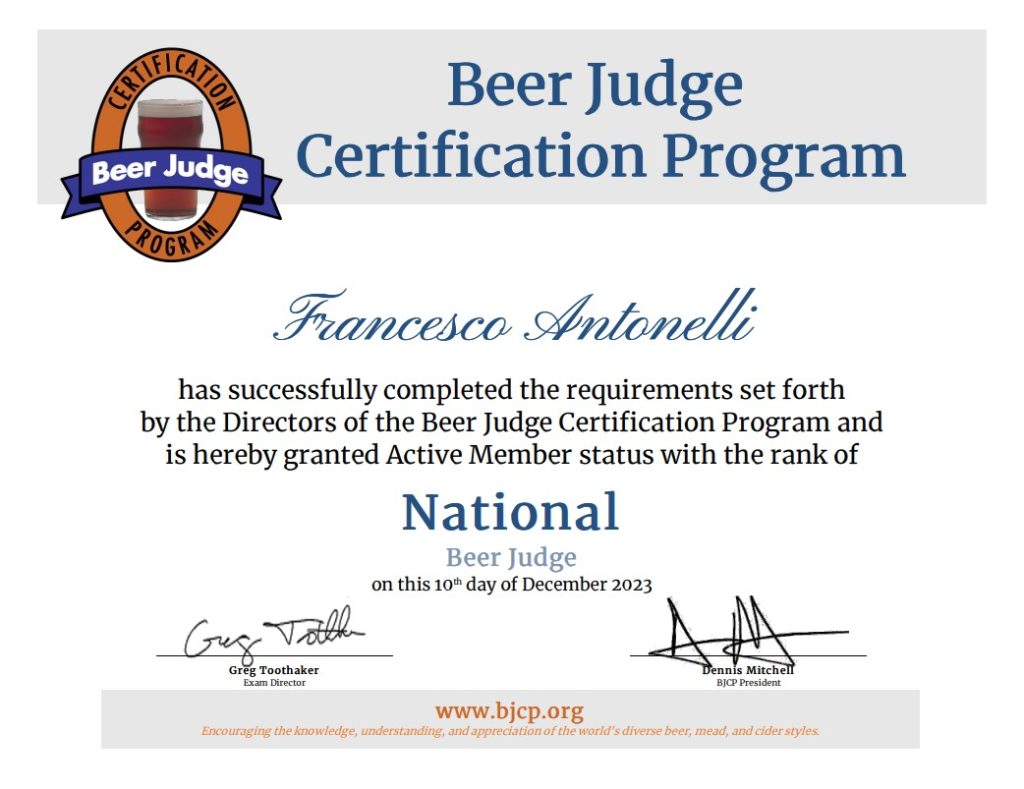
This is the blog post that I have been craving to write for over a year. My score is a stunning 93 out of 100. I still can’t believe that it went that well. I am a National BJCP judge now! [UPDATE: two years later, I reached the Grand Master rank]
I’ve previously posted a couple blog pieces about getting ready for my exam (here). I wasn’t sure how well I did, so I didn’t go over each exam question in depth. Before offering advice on how to respond to the exam questions, I wanted to confirm that my strategy had worked. It definitely did.
To know more about the Written Exam structure, please read here.
I’ll be referencing both my Written Exam papers and the RTP (Response to Participant), which you can download by clicking on the links below:

My background
I studied hard for this test. I began to get into it in January 2022, which was almost ten months before the exam. I started out slowly for the first three months before getting into a tight schedule. Every day, I made an effort to practice at least one or two answers (my Written Exam generator helped a lot). Practicing for this exam doesn’t require drinking any beer, so it was easy to squeeze a practice session into my daily routine.
I must say that when I started studying for this test, I already had a solid background in beer and brewing. I had brewed over 100 batches as a homebrewer over the course of ten years. I had written a 400-page technical book about homebrewing and had been teaching beer tasting and homebrewing for over five years. I already had several years of experience as a beer judge.
This is not to boast, but to underline that I already had a solid theoretical and practical foundation before starting to study for this exam. I just had to focus on honing my handwriting, organizing my essay, and deepening my already fair knowledge of the BJCP beer styles. I already knew a lot about ingredients, methods, off-flavours, and the brewing process in general.
More about my experience in the beer world here (in English).
How it went
I am working on a bunch of future blog entries where I will go into detail on how to tackle each exam question [UPDATE: I have since written several posts about it, the first of the series here]. For now, let’s just have a quick look at my exam and the RTP.
I received an 80/100 on the Tasting Exam a few years ago (more on that here). It follows that in order to become a National judge, I also had to receive at least an 80 out of 100 on the Written Exam. That would have worked, but it would also have meant that – in order to advance to the Master Level – I would have needed to retake the Written Exam. I didn’t like the idea of going through this hordeal again. So I decided to set my bar high and really get down to it.
It worked.
Now I can forget about the Written Exam forever and just retake the Tasting Exam someday in the future to score an 87/100 [UPDATE: I did it, and I got a stunning 91/100!]. It’s not easy, but it is doable. Let’s be honest, the Tasting Exam is far more fun than the Written Exam. I think you will agree with me on that.
Now let’s have a look at my Written Exam.
(Q0) T/F questions
The first section is a list of 20 True/False questions pulled randomly from a set of 124 questions. The list is here, together with all the correct answers. You won’t get any points from this section. Conversely, you will lose 0.5 points for every wrong answer.
This is the only question that I already wrote about because I knew I did well on this one. Please read here for more.
With some practice, the 20 questions can be easily answered in 2 minutes or less. It becomes a sort of automatic reflex.
(Q1) Mini-essay on beer styles
There are two styles-related questions. Though they include distinct triplets of beer styles, they have the same structure. For each of the two questions, you must describe and contrast three different beer styles. It is a sort of mini–essay on beer styles
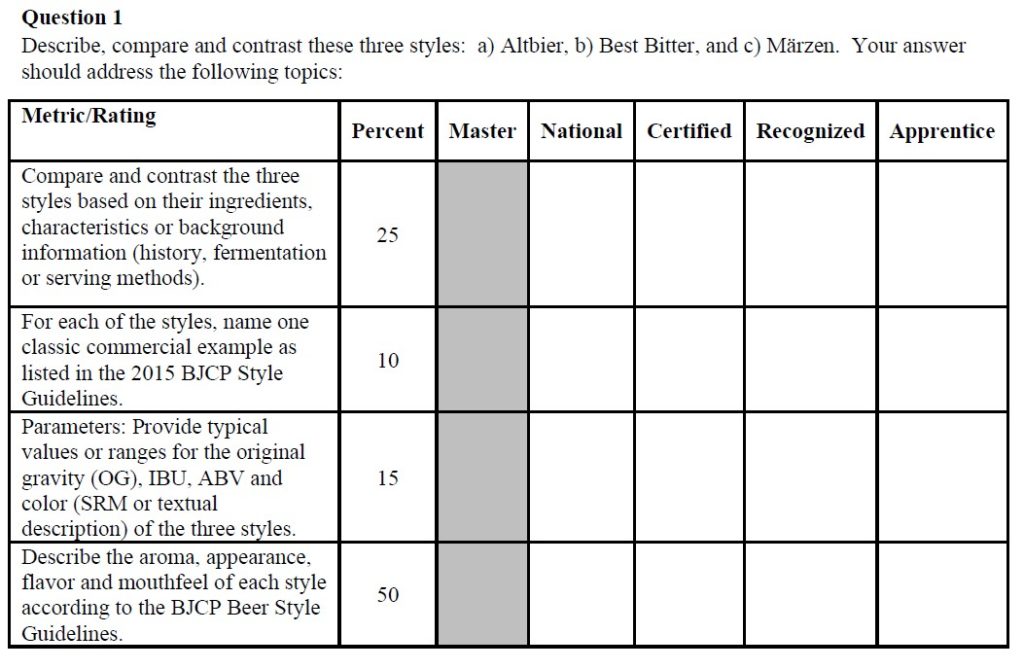
The description of each style should go through all the main characteristics, such as appearance, aroma, flavour, mouthfeel. This part weighs 50% of the total question score.
Your essay should go through differences in ingredients, serving methods, history, and nationality. This part weighs 40% of the overall question score.
When I took the exam, it was still necessary to list ABV, OG, IBU, and SRM ranges for each style. Thankfully, this is no longer required (see here for additional information). Although a commercial example for each style must still be written down, these are far easier to remember than all of them fricking numbers. This simple list of three commercial examples contributes to 10% of the total score of the question.
For the first mini-essay, I had to compare and contrast an Altbier, a Best Bitter, and a Märzen.
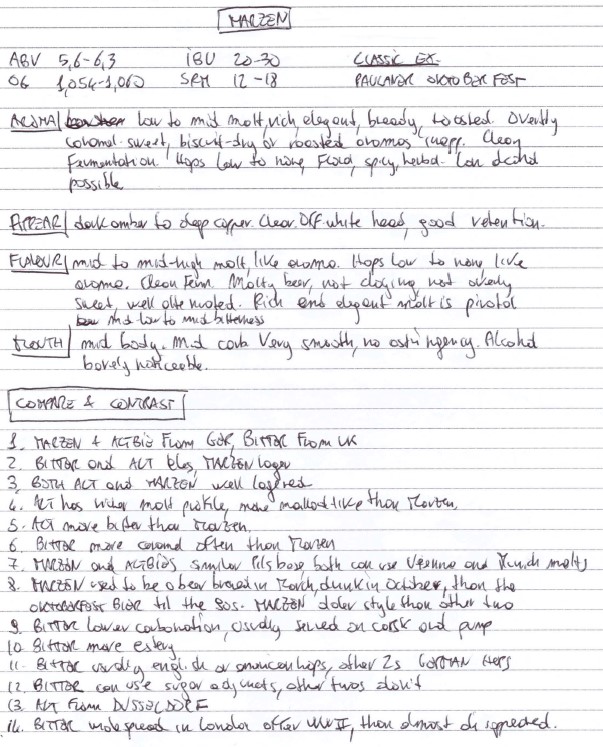
I eventually chose not to follow Al Boyce’s recommendations (here) to use tables for describing and comparing styles. When I first started practicing, I attempted to follow his advice, but I quickly discovered that I was just wasting time drawing all the tables. Furthermore, the table structure severely restricted my writing flow when I was jotting down the style traits, reducing them to a few vague words with not enough depth of meaning.
It’s not that graders dislike the Al Boyce tabular approach, or that I don’t think it’s a good idea. Simply put, I find it very challenging to convey a thorough understanding of beer styles when utilizing tables.
On the other hand, I didn’t like the idea of writing a lengthy text essay because it would be difficult to write, read, and grade. As a result, I chose to stick with a schematic strategy but at the same time I avoided drawing any tables.
I prepared to write down this answer in 18 minutes, using 3 sheets of paper. Since answering some style questions may take up to 20 minutes, set yourself to answer both of them in 38 minutes. You will have 2 minutes spare to manage a longer-than-usual answer (my strategy to tackle this question is here).
As an example, this is my answer to the Märzen style and the compare and contrast part of the first question. It went well. I was lucky, because I knew the style fairly well.
However, luck is not entirely random.
The triplets pool from which the style questions are randomly chosen is here. There are 91 triplets. They cover 84 styles. The Märzen style is the one that appears more frequently in the styles triplets. 11 out of 91. This is a 12% probability that it would be part of the exam. This is why I focused on this style and a bunch of others. More on that approach in a future post.
(Q2) Style recipe mini-essay
As I said, I am a homebrewer. I have been publishing recipes on this blog for more than ten years. I regularly teach homebrewing courses and I wrote a book about homebrewing. I couldn’t fail this question. And I didn’t.
The recipe that can appear in the Written Exam is drawn from a pool of 12 styles. Once again, I was fortunate. Even though Weissbier isn’t my favorite style—to put it mildly—, the recipe is actually pretty simple.
In this mini-essay, you must describe the beer style (15% in weight), provide the target parameters of your recipe (15%), list the ingredients, explaining why you chose them and how you calculated their quantities (40%), and finally describe the brewing procedure in detail (30%). It is a tough ride, especially for those who are not brewers or homebrewers.
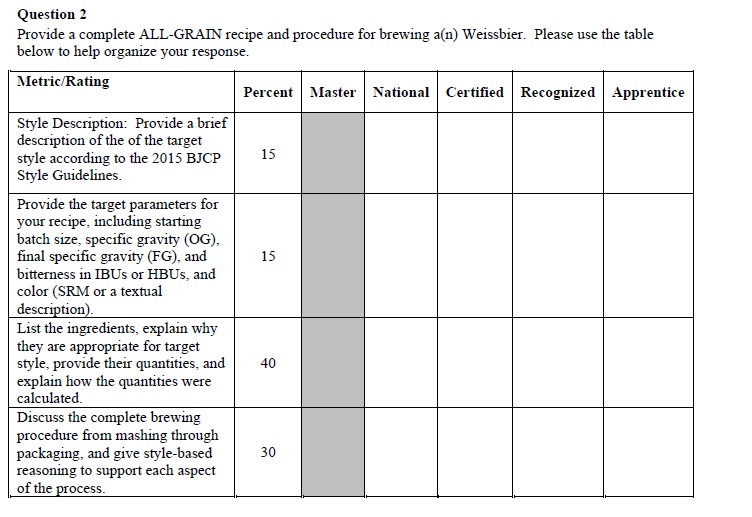
I prepared some easy-to-remember calculations for IBUs and Gravity Points (my strategy to tackle this question is here). I have an engineering and economic background, so I like to crunch numbers. The answer flowed almost by itself. More on that in a future post.
The style description was, of course, part of the pool that I focused on. It makes sense to focus on the 12 styles which can show up in the recipe question.
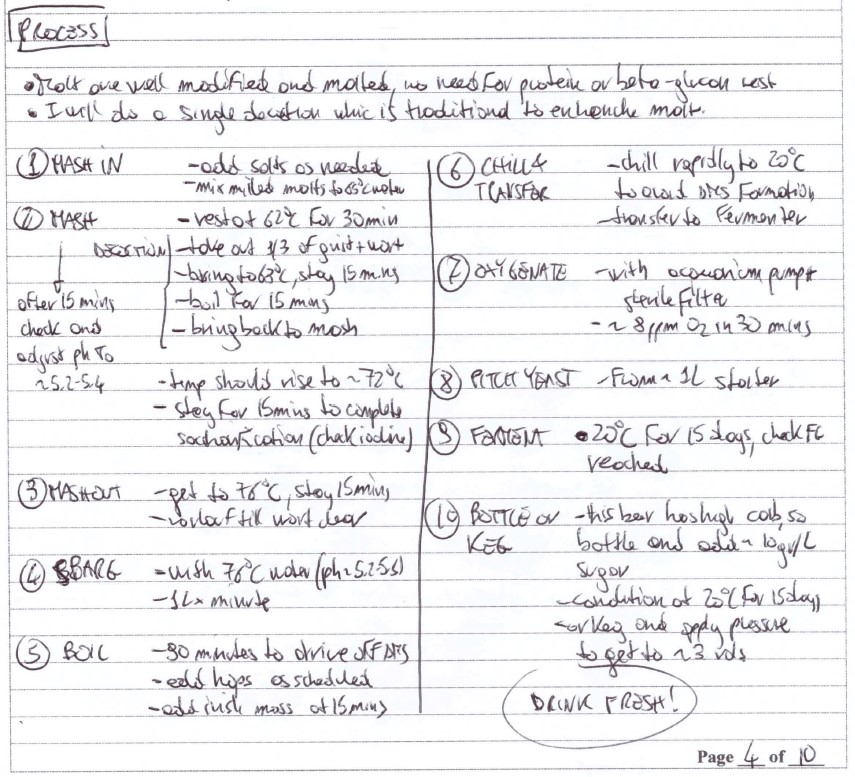
I prepared to write down this answer in 20 minutes, using 2 sheets of paper. This is an extract from my Written Exam where I described the brewing process.
(Q3) Mini-essay on beer styles
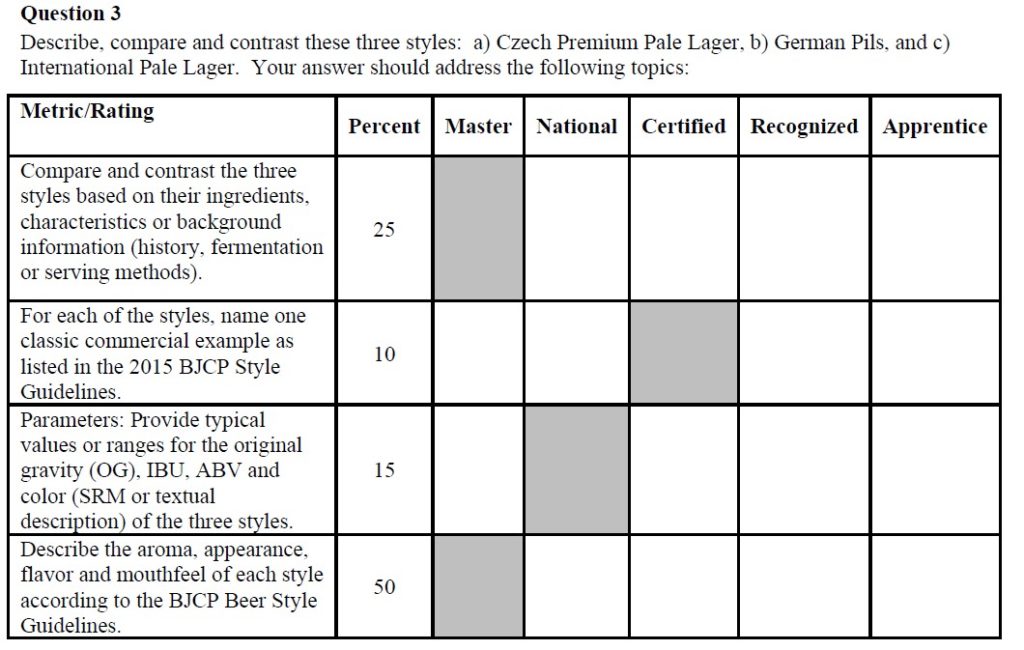
On the second triplets question, I was asked to write about Czech Premium Pale Lager (aka Czech Pils), German Pils and International Pale Lager.
While I wrote down good comparisons and descriptions of the three styles, I did not get the ranges completely right (but enough to get a National score on this part of the answer). Additionally, while Budweiser—or Bud, as it is known in Europe—is a traditional American lager, I write it as a commercial example for the International Pale Lager, which was a rookie mistake. That got me a Certified on the Classic Style Examples. Fair enough.
(Q4) Mini-essay on beer characteristics
Three beer characteristics —mostly off-flavors—must be compared, chosen from this pool of 14. A further question relates to body and mouthfeel, expanding the pool to include 15 different beer characteristics.
When I began preparing for the exam, I already had fairly deep knowledge about off-flavours in beer. It was some years ago when I published a sort of compendium about off-flavours (here, in italian). After that, I continued to study them. I also regularly teach off-flavours in tasting courses where we use samples from the Aroxa off-flavours kit. I just had to focus on writing the answer in a concise but readable format.
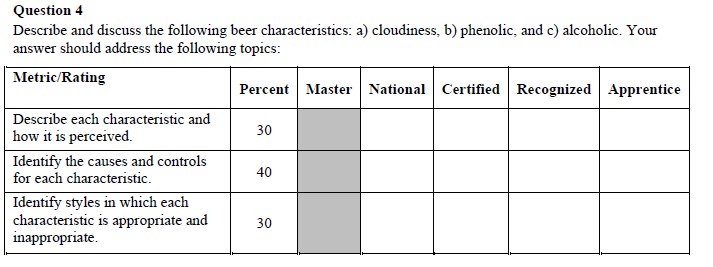
In this mini-essay, you must describe the beer characteristics (30% in weight), identify causes and controls (40%) and list styles in which the characteristics are OK or not OK (30%).
I prepared to write down this answer in 15 minutes, using 2 sheets of paper (5 minutes per characteristic).
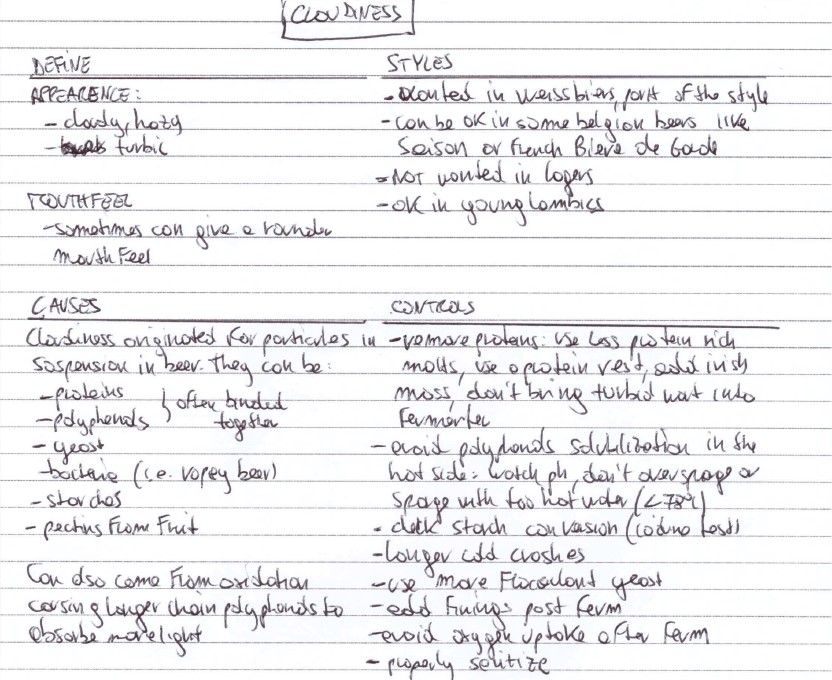
I had to talk about cloudiness, phenols, and alcohols.
Once more, I avoided using tables in favor of focusing on clarity. However, I arranged my response into four quadrants with bullet points inside them.
(Q5) Mini essay on process and ingredients
Given how much general beer knowledge it requires, this may be the hardest question to answer. Preparing for this question can be overwhelming. It can require reading entire books about brewing.
It must be said that the topics are not random but chosen from this pool of 6. The BJCP Written Exam Study Guide is a good resource to start preparing for this question, but probably won’t be enough.
The main focus here is organizing the answer in a concise and easy-to-read fashion. This will give you a guide while writing the answer. Otherwise, you can easily go off on a tangent and lose focus.
I prepared to write down this answer in 15 minutes, using 2 sheets of paper. A few more or fewer minutes are needed for some of the topics. I planned my exam schedule such that I would have a minimum of two minutes left for emergencies.
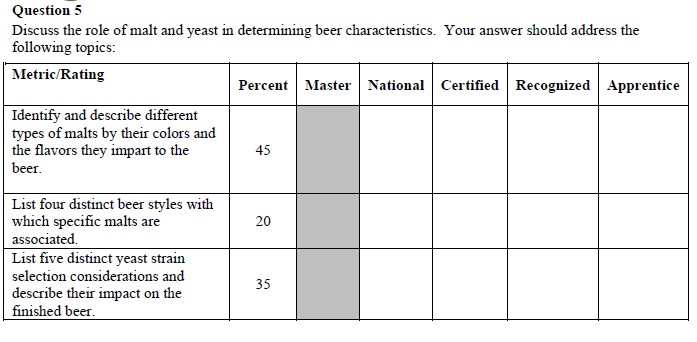
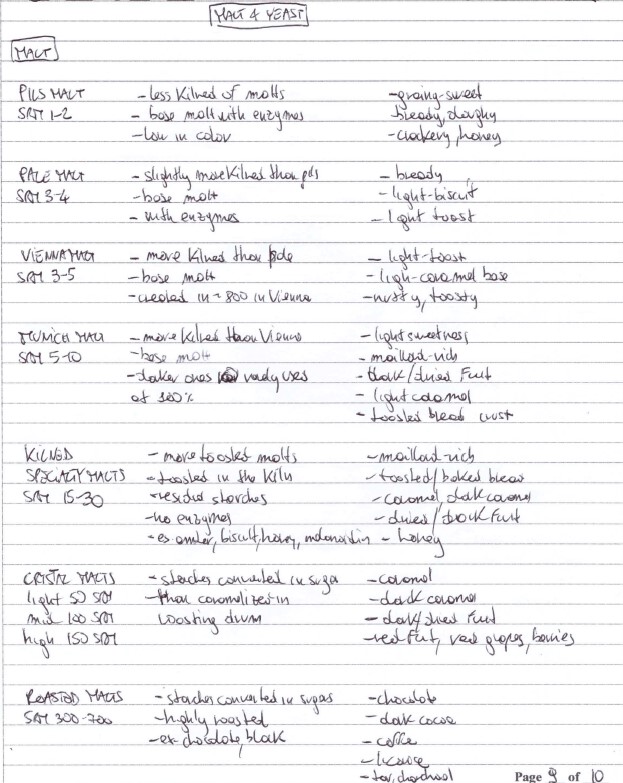
I prepared an organized answer for each question, and it did pay back. I didn’t get the easiest one, but I was prepared. I had to talk about malt and yeast.
 This is how I answered the malt part of the question in an organized fashion. My hand was starting to get tired, but I hung in there.
Was it worth it?
I already talked about this in another post (here). The concise answer is yes, it was.
It was not easy, though. It required a lot of patience, focus, and method. But it was useful. It helped me organize and deepen my knowledge about styles. I didn’t really know them as well as I thought I did. Reading the guidelines with more attention made me notice details that I hadn’t really taken in before.
Now that I am National judge, I can finally contribute more concretely to the BJCP program by helping with proctoring and grading. I will take the Tasting Exam again some time in the future, probably after some more judging, a bit of proctoring and some grading.
More detailed posts about preparing for the Written Exam are on the way. Stay tuned.
 Come ho fatto a prendere 93/100 al Written Exam del BJCP
Ho sostenuto il Written Exam BJCP il 15 ottobre dello scorso anno (2022). È andato abbastanza liscio: niente crampi alla mano, niente intoppi, ho scritto parole su parole senza esitazioni. Nel complesso mi sembrava fosse andata bene. In quel momento però non potevo immaginare quanto fosse andato bene.
Questo è il post che desideravo scrivere da più di un anno. Il mio voto d’esame è un clamoroso 93/100! Fatico ancora a crederci: sono un giudice BJCP National! [UPDATE: due anni dopo, sono arrivato al livello Grand Master]
In passato ho pubblicato un paio di post sulla preparazione all’esame (qui). Non sapevo come fosse andata, quindi non sono entrato nel dettaglio di ogni domanda. Prima di dare consigli su come rispondere alle domande dell’esame, volevo la conferma che la mia strategia avesse funzionato. Ha funzionato, direi.
Per saperne di più sulla struttura del Written Exam, leggi qui.
Farò riferimento sia ai miei elaborati del Written Exam sia alla RTP (Response to Participant), scaricabili dai link qui sotto:
Il mio percorso
Ho studiato parecchio per questo esame. Ho iniziato a dedicarmi seriamente allo studio a gennaio 2022, quasi dieci mesi prima della prova. I primi tre mesi sono andato avanti con molta calma, poi sono passato a un ritmo serrato.
Ogni giorno mi sforzavo di esercitarmi su almeno una o due risposte (il mio Written Exam generator mi ha aiutato molto). Esercitarsi per questo esame non richiede di bere birra: era facile ritagliarsi una sessione di pratica nella routine quotidiana, anche al mattino presto, prima di iniziare a lavorare.
Devo dire che quando ho iniziato a studiare per questo esame avevo già un bagaglio solido su tutto ciò che riguarda birra e homebrewing. Avevo prodotto oltre 100 cotte come homebrewer nell’arco di dieci anni. Avevo scritto un libro tecnico di 400 pagine sull’homebrewing e insegnavo degustazione di birra da oltre cinque anni in vari corsi. Avevo già diversi anni di esperienza come giudice di birra.
Non lo dico per vantarmi, ma per sottolineare che le mie basi teoriche e pratiche erano già piuttosto avanzate ancor prima di mettermi a studiare per questo esame. Avevo però bisogno di allenarmi a scrivere lunghi testi a mano, affinare la calligrafia, organizzare la strategia di risposta alle domande d’esame e sistematizzare meglio una conoscenza già avanzata degli stili birrari del BJCP. Sapevo già molto su ingredienti, metodi, difetti e processo produttivo in generale.
Maggiori dettagli sulla mia esperienza nel mondo della birra qui.
Come è andato l’esame
Sto lavorando a una serie di futuri post del blog in cui entrerò nel dettaglio su come affrontare ogni domanda dell’esame [UPDATE: ne ho scritti diversi, il primo della serie qui]. Per ora diamo solo una rapida occhiata al mio esame e al RTP.
Ho preso 80/100 al Tasting Exam qualche anno fa (maggiori dettagli qui). Ne consegue che per diventare National judge dovevo ottenere almeno 80 su 100 anche al Written Exam. Sarebbe bastato, ma avrebbe anche significato che per avanzare al livello Master avrei dovuto ripetere il Written Exam per puntare a un voto più alto. Non mi andava di passare di nuovo attraverso questo calvario, così ho deciso di alzare l’asticella e mettermi a studiare sul serio, puntando in alto da subito.
Ha funzionato.
Ora posso dimenticarmi del Written Exam per sempre e in futuro ripetere solo il Tasting Exam, per arrivare a un punteggio di 87/100 [UPDATE: l’ho fatto e ho preso 91/100!]. Non è facile, ma è fattibile. Diciamocelo pure: il Tasting Exam è molto più divertente del Written Exam. Immagino sia difficile non essere d’accordo su questo.
Adesso diamo un’occhiata al mio Written Exam.
(Q0) Domande Vero/Falso
La prima sezione è un elenco di 20 domande vero/falso, estratte casualmente da un insieme di 124 domande. L’elenco è qui, insieme a tutte le risposte corrette. In questa sezione non si guadagnano punti: al contrario, si perdono 0,5 punti per ogni risposta sbagliata.
Questa è l’unica domanda di cui ho già scritto, perché sapevo di essere andato bene su questa parte. Per saperne di più, leggi qui.
Con un po’ di pratica, le 20 domande si possono rispondere facilmente in 2 minuti o anche meno: diventa una sorta di riflesso automatico.
(Q1) Primo mini-saggio sugli stili
Due delle domande del Written Exam sono relative agli stili birrari. Anche se ciascuna coinvolge una tripletta diversa di stili birrari, seguono la stessa struttura. Per ognuna delle due domande bisogna descrivere e mettere a confronto tre diversi stili: una sorta di mini-saggio sugli stili birrari.
La descrizione di ogni stile deve toccare tutte le caratteristiche principali, come aspetto, aroma, gusto, corpo. Questa parte pesa il 50% del punteggio totale della domanda.
Il saggio deve trattare le differenze in ingredienti, metodi di mescita, storia e nazionalità. Questa parte pesa il 40% del punteggio complessivo della domanda.
Quando ho sostenuto l’esame, era ancora necessario elencare i range di ABV, OG, IBU e SRM per ogni stile. Per fortuna non è più richiesto (per maggiori informazioni vedi qui). Anche se bisogna comunque citare un esempio commerciale per ogni stile, questi sono decisamente più facili da ricordare rispetto a tutti quei maledetti numeri. Questo semplice elenco di tre esempi commerciali contribuisce per il 10% al punteggio totale della domanda.
Per il primo mini-saggio ho dovuto confrontare un Altbier, una Best Bitter e una Märzen. Su questa tripletta ho raggiunto il livello Master su tutte le voci di valutazione.
Alla fine ho scelto di non seguire i consigli di Al Boyce (qui) sull’uso delle tabelle per descrivere e confrontare gli stili. Quando ho iniziato a esercitarmi ho provato a seguire il suo consiglio, ma ho scoperto in fretta che ogni volta perdevo tempo prezioso a disegnare i bordi delle tabelle con il righello. Senza righello venivano orribili e difficili da leggere. Inoltre la struttura tabellare limitava parecchio il flusso della scrittura nel momento di annotare le caratteristiche degli stili, riducendole a poche parole vaghe e prive di sufficiente profondità. Alla fine, le descrizioni sembravano tutte uguali.
Non sto dicendo che chi corregge l’esame disdegni l’approccio tabellare di Al Boyce, né che io lo consideri una cattiva idea. Semplicemente trovo molto difficile trasmettere una comprensione approfondita degli stili birrari utilizzando le tabelle. Come ho già scritto, puntavo in alto: le tabelle semplicemente non mi sembravano lo strumento adatto per arrivare dove volevo arrivare.
D’altra parte non mi piaceva nemmeno l’idea di scrivere un lungo saggio in prosa, perché sarebbe stato difficile da mettere insieme, da leggere e da correggere. Di conseguenza ho scelto di mantenere una strategia schematica, evitando però di disegnare tabelle.
Mi sono organizzato per scrivere questa risposta in 18 minuti, riempiendo 3 fogli pieni. Dato che rispondere ad alcune domande sugli stili può richiedere fino a 20 minuti, conviene darsi 38 minuti totali come obiettivo per rispondere a entrambe. Restano così 2 minuti di margine per gestire una risposta più lunga del solito (qui la mia strategia in dettaglio per affrontare questa domanda).
Come esempio, nel seguito il mio mini-saggio sullo stile Märzen e sulla parte di confronto della prima tripletta. È andata bene: sono stato fortunato, perché conoscevo lo stile abbastanza bene.
La fortuna, però, non è del tutto casuale.
Il pool di triplette da cui vengono estratte casualmente le domande sugli stili è qui. Ci sono 91 triplette, che coprono 84 stili. Lo stile Märzen è quello che compare più frequentemente nelle triplette: 11 su 91. Questo significa una probabilità del 12% che faccia parte dell’esame. Per questo motivo mi sono concentrato soprattutto sulla memorizzazione di questo stile e su alcuni altri. Ne parlo più nel dettaglio in questo post.
(Q2) Formulazione di una ricetta
Come ho già detto e come molti sanno, sono un homebrewer. Pubblico ricette su questo blog da oltre dieci anni. Insegno regolarmente corsi di homebrewing e ho scritto un libro sull’argomento. Non potevo cannare questa domanda. E infatti non l’ho fatto.
La ricetta che può comparire nel Written Exam viene estratta da un pool di 12 stili. Anche qui sono stato fortunato: sebbene le Weissbier non siano il mio stile preferito, scrivere una ricetta per una Weizen è piuttosto semplice (pochi ingredienti, una sola aggiunta di luppolo in amaro).
In questo mini-saggio bisogna descrivere lo stile birrario (15% del peso), fornire i parametri obiettivo della ricetta (15%), elencare gli ingredienti spiegando perché sono stati scelti e come sono state calcolate le quantità (40%) e infine descrivere in dettaglio il procedimento di produzione (30%). È una prova impegnativa, soprattutto per chi non è un birraio o un homebrewer. Anche qui, ho raggiunto il livello Master su tutte le voci di valutazione.
(Q3) Secondo mini-saggi sugli stili
La seconda domanda sulle triplette chiedeva di confrontare gli stili Czech Premium Pale Lager (aka Czech Pils), German Pils e International Pale Lager.
Questa tripletta è andata meno bene rispetto all’altra. Non ho azzeccato del tutto i range numerici, ma abbastanza da ottenere comunque un punteggio National su questa parte della risposta. Ho sbagliato l’esempio di stile per la Internation Pale Lager, citando la Budweiser americana come esempio commerciale: un errore stupido, avrei potuto facilmente citare Heineken o Moretti (la Bud è ovviamente un esempio di American Lager). Questo mi è valso un Certified sulla voce Classic Style Examples. Vabbè, non si può essere perfetti.
(Q4) Mini saggio su difetti e caratteristiche della birra
Questa domanda chiede di confrontare tre caratteristiche della birra, per lo più difetti, scelte da questo pool di 14. La risposta deve coprire anche corpo e mouthfeel, ampliando il pool a 15 diverse caratteristiche della birra.
Quando ho iniziato a prepararmi per l’esame, avevo già una conoscenza piuttosto approfondita dei difetti della birra. Anni fa avevo pubblicato una sorta di compendio sui difetti (qui) e scritto molti articoli sui difetti qui sul blog. Da allora ho continuato a studiarli. Insegno regolarmente i difetti nei corsi di degustazione, dove usiamo i campioni del kit difetti Aroxa. Dovevo solo concentrarmi sullo scrivere la risposta in un formato conciso ma leggibile.
In questo mini-saggio bisogna descrivere la caratteristica/difetto della birra (30% del peso), identificarne le cause e descrivere potenziali rimedi (40%), e infine elencare gli stili in cui tali caratteristiche/difetti sono accettabili (30%).
Mi sono organizzato per scrivere questa risposta in 15 minuti, usando 2 fogli di carta (5 minuti per caratteristica/difetto).
Mi sono capitati torbidità, fenoli e alcoli. È andata molto bene anche questa domanda.
Ancora una volta ho evitato le tabelle, preferendo puntare sulla chiarezza. Ho però organizzato la risposta in quattro quadranti, con elenchi puntati al loro interno.
(Q5) Mini-saggio su processo e ingredienti
Vista la quantità di conoscenza generale sulla birra che richiede, questa potrebbe essere per molti la domanda più difficile a cui rispondere. Prepararsi per questo mini-saggio può risultare particolarmente impegnativo perché richiede di leggere interi libri sulla produzione della birra.
Va detto che gli argomenti non sono casuali, ma scelti da questo pool di 6. La BJCP Written Exam Study Guide è una buona risorsa per iniziare a prepararsi su questa domanda, ma probabilmente non basta.
Il focus principale qui è organizzare la risposta in modo conciso e facile da leggere: una struttura logica solida fornisce una guida mentre si scrive, altrimenti si finisce facilmente fuori tema e si perde il filo della risposta.
Mi sono organizzato per scrivere questa risposta in 15 minuti, usando 2 fogli. Per alcuni argomenti servono un po’ più o un po’ meno minuti. Ho pianificato la scaletta dell’esame in modo da avere almeno due minuti di margine per le emergenze e per eventualmente gestire questa risposta.
Mi ero preparato una risposta strutturata per ognuno dei 6 temi. Ha funzionato. Non mi è capitato l’argomento più facile, ma ero preparato. Mi sono capitati malto e lievito. Master anche qui, su tutte le voci. Bingo!
Ecco come ho risposto in modo organizzato alla parte sul malto della domanda. La mano cominciava a stancarsi, ma ho tenuto duro.
Ne è valsa la pena?
Ho già affrontato il tema in un altro post. La risposta concisa è: sì, ne è valsa la pena.
Non è stato facile. La preparazione ha richiesto molta pazienza, concentrazione e metodo. Ma è stato utile: mi ha aiutato a organizzare e approfondire la conoscenza degli stili. Non li conoscevo così bene come pensavo. Leggere le linee guida con più attenzione mi ha fatto notare dettagli che prima non avevo davvero colto.
Ora che sono National judge, posso finalmente contribuire in modo più concreto al programma BJCP, aiutando con proctoring e valutazioni. Riprenderò il Tasting Exam in futuro, probabilmente dopo aver giudicato ancora un po’, fatto un po’ di proctoring e qualche valutazione.
Altri post più dettagliati sulla preparazione al Written Exam sono in arrivo. Restate sintonizzati.



Congratulations Frank! That’s so impressive!
It’s well known the scoring 90+ is exremely difficult.
It’s interesting like you I chose not to use the Al Boyce recommendations because like you felt I was spending too much time drawing tables.
Well wouldn’t you know it.
Al Boyce was one of my graders!
My score of 83 was fair though.
I see areas where you provided more and better detail than I did.
Ah ah, incredible coincidence! Al’s it’s not a bad approach, just I didn’t feel comfortable with it. But it can work for others.
Thanks for sharing this Francesco and congratulations on the achievment! This is going to be really useful since I’m prepping myself to take the written exam next year.
I guess as a grader you will learn some tricks to increase the tasting score since you will answer the exam thinking like a grader.
The only thing I strongly disagree with you is about Weissbier hahaha… cheers!
Ah ah! Actually, I enjoy Weissbiers with restrained banana aromas. It’s not the style itself that I dislike; it is the banana aroma that often characterizes the style.
It is just a matter of personal preference in the end. I know that, as a judge, I should get over it. I am trying and I will succed eventually! 🙂
I hope my sharing will be helpful to you as you study. Good luck!
Grande Frank!! 🔝🔝🔝
Approccio ingegneristico per superare l’esame bjcp 🙂
Veramente i miei più vivi complimenti!!
Thats a great acheivement Frank. Congrats!
I am thinking about preparing the written exam and google brought me here. Your blogs are truely the best resources I’ve found online.
In order to get a good score here, It seems to me that you have to memorize all the detail of the 84 styles down to SRM ranges….that’s a lot of homework to do.
I just got my tasting score back, and I need exact 93 in written to make me a master. Mission inpossible for me now lol
Thanks Vence! Well, you got a very good score at the tasting exam than! Finally it’s no longer required to memorize all the technical details about the styles for the Written Exam. Nonetheles, it’s still is a hard exam to tackle. Good luck with the studying!
Hello Frank! How long does it take for BJCP to grade the exam? I saw you took the exam in Oct 2022. So when did you get the result?
My case was a an exceptiion; it took more than a year to be graded. But it was a period when the BJCP was having great difficulty grading exams, particularly the Written ones. Other friends of mine who took the Written Exam on February this year received their results within about seven months.
thank you! i will be taking it this sunday. seems like i would gotta wait until next summer to know the result.
Good luck with your exam!