

After delving into the T/F and the triplets questions, it’s time to tackle the recipe question.
This one can be tough for judges who are unfamiliar with recipe design and have not experienced the brewing process firsthand. Fortunately for me, I had homebrewed more than 120 batches at the time of the written exam and had been releasing recipes on this blog for several years.
Nonetheless, it needed considerable planning and memory exercises to tackle down all the 12 recipes of the exam pool.
To learn more about the Written Exam structure, please read here.
To learn more about the T/F questions, please read here.
To learn more about the Triplets question, pleas read here.

The recipe question
This question consists of four parts:
- Describe the style (no numbers are needed). 15% of the total score
- Provide the recipe’s target parameters. 15% of the total score
- List all the ingredients (with weights and rationals). 40% of the total score
- Discuss the complete brewing procedure. 30% of the total score
The recipes are taken from a pool of 12, listed on the official BJCP website (link). These styles you should already know perfectly as part of the strategy to tackle the Styles Triplets question, discussed in a previous post.
This is a difficult question for people who are unfamiliar with the recipe design process. Some may find it easier to skip all of the math that I will describe in the following paragraphs and simply learn the ingredient quantities by heart. That would be a viable alternative, but it wasn’t the case for me. I already had a lot of information to remember for the styles questions, there just wasn’t enough room left in my head.
I am a homebrewer. I design beer recipes on a daily basis using software that does the math for me. I just had to find a way to do the basic calculations on paper; the recipes would come from my experience in brewing.
I trained myself to answer the entire question in 20 minutes, using a calculator to obtain the correct numbers. Try to use no more than two pages (two and a half tops) for your answer.
Memorizing recipes numbers
The first step is to write down the recipe’s statistics and memorize them. I didn’t want to memorize too much info, so I organized the OG, IBU, and other numbers into groups. The end result is the table shown below.
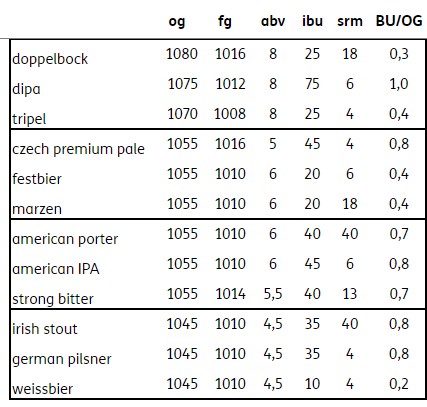 To make it easier to remember the numbers, the 12 recipes can be organized by OG, ABV, and SRM. Six out of twelve recipes have an OG of 1.055, three have an OG of 1.045, and three have OGs of 1.080, 1.075, and 1.070, all of which are 0.005 points apart.
A similar approach can be used to categorize ABVs and FGs, with a few easy-to-remember exceptions, such as Czech Premium Pale Lager (less attenuated, lower ABV) or Double IPA and Belgian Tripel, which have more attenuation and a higher ABV with a lower OG.
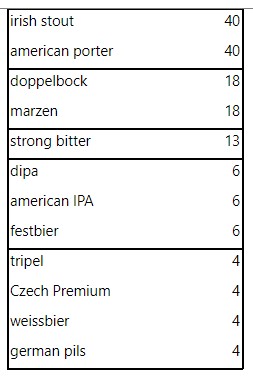
Grouping the beer by SRM yields five categories that are rather easy to remember.
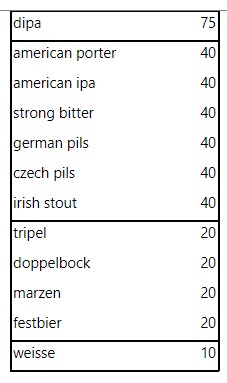
Grouping by IBU produces four groups:
The recipes
Any of these 12 beers can be brewed with three malts or fewer. There is no need to write elaborate malt bills. Keep hop additions basic, with one at 60 minutes, one at 5 minutes, and one in dry hopping if necessary. The Double IPA could benefit from additional hops at 15 minutes, but it is the only exception.
Most recipes call for Chico strain yeast, whereas the lagers all use the same W34/70 yeast, with the exception of the Czech, which prefers Bohemian Lager yeast. The Belgian Tripel, Weisse, and Strong Bitter may all be made with these three yeast strains: Belgian High Gravity, Weihenstephan Weizen, and London Ale I.
Reliable sources for recipes include the American Homebrewers Association website with medal-winning recipes and Zainasheff and Palmer’s recipes book. You can also consult my Homebrew To Style recipes handbook, to which I add new recipes each month.
This blog contains recipes for ten of the twelve exam beers; links to each are provided below:
- Double IPA
- American Porter
- American IPA
- Strong Bitter (you can boost the Best Bitter recipe I provided)
- German Pils
- Czech Pils
- Irish Stout
- Belgian Tripel
- Doppelbock
Keep the recipes as simple as possible, paying special attention to using the right malts and hops and achieving the ideal parameters. My recommendation is to use recipe software such as Brewfather to ensure that all of the parameters for the 12 recipes are accurate.
How to calculate malt quantities
Instead of memorizing weights, I chose to use percentages versus the total grist. So, for example, a Weissbier grist is 50% Pilsner and 50% Malted Wheat. There is no wrong recipe as long as you use the main ingredients of the style in the right percentage range.
Once you have memorized each style’s statistics and grain proportions, quantities must be calculated. The formula to calculate how each malt contributes to the overall recipe in terms of Gravity Points which add up to the OG (Original Gravitiy) is the following:
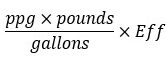
where ppg is the malt potential (Pounds Per Gallon) and Eff is the brewhouse efficiency. 10 pounds of a classic base malt with a 1.036 ppg potential used in a typical 4 gallons batch with 75% efficiency will contribute 67.5 Gravity Points.
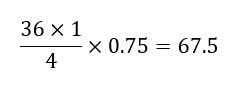
In other words, a 4 gallons batch made with 10 pounds of this malt in a 75% efficiency brewhouse will produce a 1.068 OG beer.
Doing this calculation during the exam would be extremely overwhelming, even with a calculator (which can be used). With a bit of approximation, the formulas can be adjusted to our needs. I’ll talk in metric units now, but the same reasoning can be applied to US metrics.
Before you begin the calculations, state that you will use 1.030 Kg/10L (1.036 ppg) as the potential for all malts in your recipe (this is a reasonable approximation).
The batch size would be 20L and the system efficiency 70%. Using this numbers, 1 Kg of every malt will contribuite circa 10 Gravity Points to the recipe.
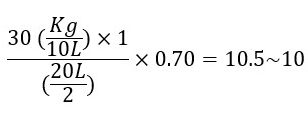 Let’s come back to the weissbier recipe. We know that the OG should be 1.045 and the recipe calls for 50% Pilsner malt and 50% malted wheat. We’ll need 45/10 = 4.5 Kg of malt in total, of which 4.5/2 = 2.25 Kg Pilsner malt and 2.25 Kg Wheat Malt.
That’s pretty much it.
With a calculator on hand, once you memorize the percentages, calculations can be done in seconds. The only caveat is simple sugars, which have a higher potential of 1.046 ppg and are converted at 100% efficiency.
Adding simple sugars is mandatory in the Belgian Tripel recipe and optional in the Double IPA. Using the formula above with 1.038 Kg/10L potential and 100% efficiency, we get that 1 Kg of sugar contribute 20 Gravity Points to the recipe.
Easy-peasy.
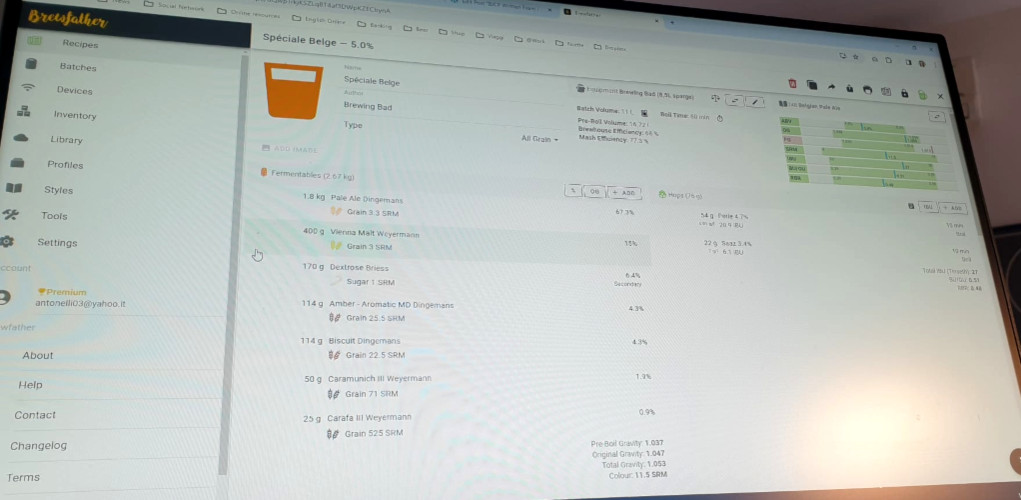
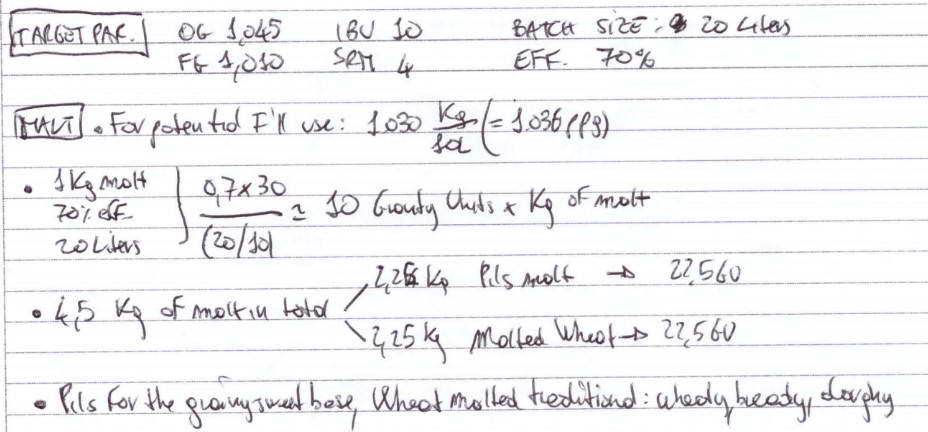
Here is my answer to the malt part of the recipe question. I was asked to write a Weissbier recipe. I brewed the style only once in my life, but the recipe is really straightforward. Don’t forget to add a few extra words to explain why you are using such malts.
 How to calculate hops quantities
A similar rationale applies to the hops. We are going to employ the Tinseth formula (with metric units):
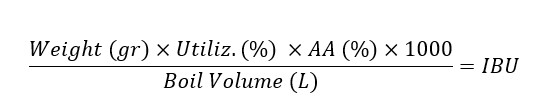
Utilization is determined by the timing of hop addition. It is reasonable to say that utilization value is:
- 25% for 60 min additions,
- 15% for 15 minutes additions,
- 0% for 5 minutes additions.
The boil volume is the starting boil volume (in this case, 25 liters).
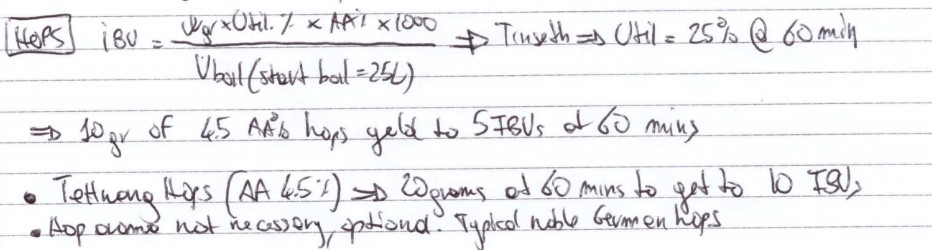
Considering hops with 5.0% AA, we get that:
- 10 grams of hops at 60 minutes contribute 5 IBUs,
- 10 grams of hops at 15 minutes contribute 3 IBUs,
- we can consider 0 the IBUs for the contribution at 5 minutes,
- dry hopping does not contribute with any IBU.
When utilizing high-alfa-acids hops (like as Chinook in an IPA), use 10% AA and just twice the above figures.
Using this framework, you can calculate hop quantities during the exam without having to memorize them.
For non-hoppy beers that require a single 60-minute addition (such as lagers, Weissbiers, and Tripels), just use a 5.0% AA hop, divide the target IBU by 5, and multiply by 10 (or just multiply by 2) to get the hop quantity. For example, a Tripel with 20 IBU requires (20/5)x10 (or 20×2) = 40 grams of any 5.0 AA% hop @ 60 minutes.
For hoppy beers, utilize g/L as a starting point for late boil additions, calculate their IBU contribution, and close the gap with a 60-minute addition.
For example, a Double IPA needs 75 IBU. Adding 6 gr/L, which is a common number in that type of beer, yields 6g x 20L (liters in the fermenter) = 120 grams of late boil hops. Divide them equally between a 60-gram, five-minutes addition (0 IBU) and a 60-gram, 15-minute addition. Using high-alpha-acid hops (10% AA), each 10 grams of hops added at 15 minutes from the end of the boil contributes 6 IBU. 60 grams @ 5 mins will then yield 36 IBU.
Fill in the 75-36=39 IBU gap with a 60-minute addition. At 60 minutes, every 10 grams of a 10% AA hop yields 5×2=10 IBU, or 1 IBU per gram. We’ll then need 39 grams of hops @ 60 minutes.
To sum up, here is the hopping schedule for a Double IPA (75 IBU, 10% AA hops):
- 39 grams @ 60 min (39 IBU)
- 60 grams (3 g/L) @ 15 minutes (36 IBU)
- 60 grams (3 g/L) @ 5 minutes (0 IBU)
Dry hopping is required, but it’s easy to add. It is easily calculated as a pxq; typically 8-10 g/L for a Double IPA, taking into account the amount of beer in the fermenter. Once the fermentation process is complete, simply add 8×20=160gr of dry hops to the fermenter if it holds 20 liters of beer. It might be more intricate than that, but for the purposes of the exam, this is sufficient.
With a calculator on hand, it is quite easy to do the math. Of course, it is far easier with a Weissbier than with a Double IPA which requires more hops. The Weissbier, on the other hand, necessitates a more complicated brewing process with a single decoction.
I was lucky enough to get a Weissbier recipe that calls only for a 60-minute hop addition. Here is my exam answer for the hop component. Don’t forget to add a line to explain why you chose the hops.
How to calculate water quantities
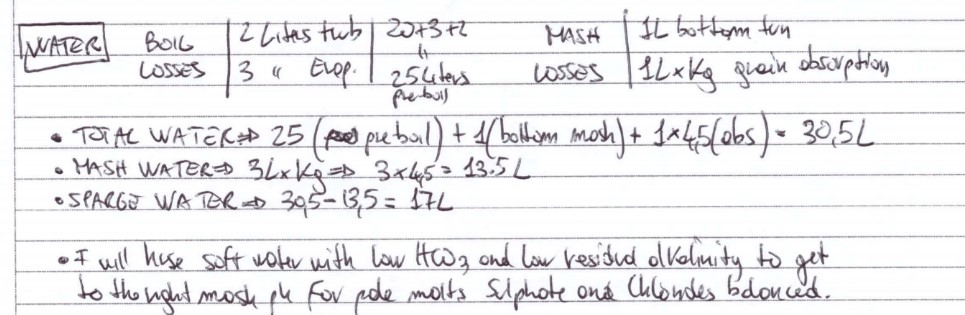
The best approach is to start from the volume in the fermenter and work your way backwards, considering:
- 2 liters of trub in the boil pot,
- 3 liters evaporation during the boil,
- 1 liter left behind in the mash tun,
- 1 L x Kg wort absorbtion by the grains after the mash.
Once the initial water quantity is calculated, use 3 L x Kg in the mash and the rest as sparge water. Don’t forget to add a line to explain how you’d treat the water.
Describing the process
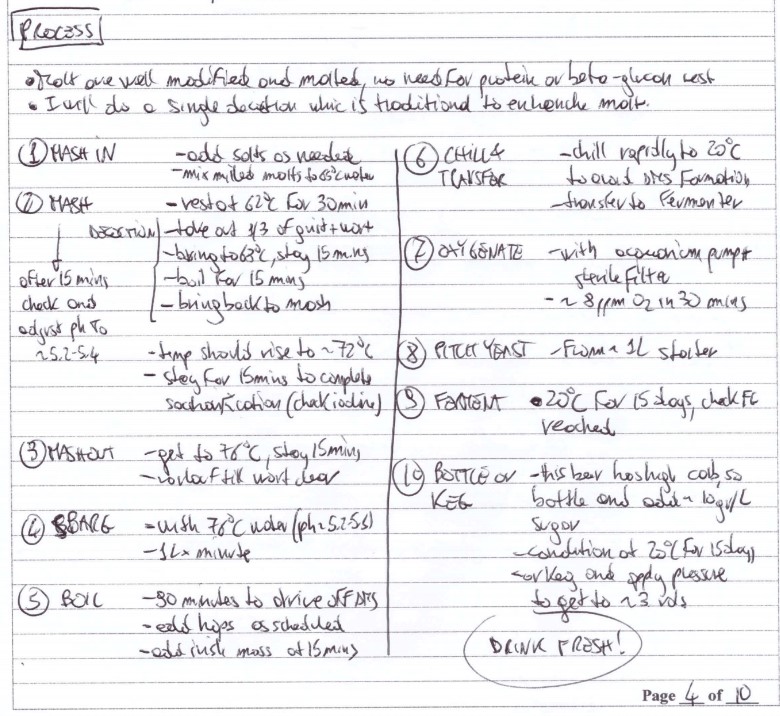
I diveded the whole process in 10 steps:
- Mash-in
- Mashing
- Mashout
- Sparge
- Boil
- Chill & Transfer
- Oxygenation
- Pitching the yeast
- Fermentation
- Bottling or kegging
Apart from the beers that usually require a decoction to boost the malt flavour (single decoction for the Weissbier and the Marzen, double decoction for the Czech Premium Pale Lager), the other ones follow the ten steps listed above.
Always specify that you won’t need additional rests (like the protein rest) because the malts are well modified. The Irish Stout is made using unmalted barley, but at 10%, it does not require any additional rest.
Decoction is easy to describe:
- take out 1/3 of the grist
- keep at 68°C for 15 mins
- bring to a boil and boil for 15 mins
- take it back to the main mash
It is important to stick to the 10 points listed above to avoid forgetting any step. Here is my answer for the Weisbeer production process:
 BJCP Written Exam / Come rispondere alla domanda sulla ricetta
Dopo aver approfondito le domande Vero e Falso e le domande sugli stili, è il momento di affrontare la domanda sulla ricetta.
Questa domanda può risultare ostica per i giudici che non hanno familiarità con la progettazione di ricette e non hanno vissuto in prima persona il processo di produzione. Per mia fortuna, quando ho sostenuto il Written Exam avevo già prodotto oltre 120 cotte in casa e da anni pubblicavo ricette su questo blog.
Ciò nonostante, mi è servita una pianificazione considerevole e un discreto sforzo di memorizzazione per venire a capo di tutte le 12 ricette che fanno parte del pool d’esame.
Per approfondire la struttura del Written Exam, qui.
Per approfondire le domande V/F, qui.
Per approfondire la domanda a tripletta, qui.
La domanda sulla ricetta
Questa domanda si compone di quattro parti:
- Descrivere lo stile secondo le linee guida, senza indicare i parametri numerici – 15% del punteggio totale
- Fornire i parametri obiettivo della ricetta – 15% del punteggio totale
- Elencare tutti gli ingredienti, con quantità e razionali – 40% del punteggio totale
- Descrivere l’intera procedura di produzione – 30% del punteggio totale
Le ricette sono estratte da un pool di 12, elencate sul sito ufficiale BJCP. Questi stili dovrebbero già essere perfettamente noti come parte della strategia per affrontare le domande sugli stili, discussa in un post precedente.
La stesura della ricetta con questo livello di dettaglio è particolarmente difficile per chi non ha familiarità con il processo di progettazione delle ricette. Alcuni potrebbero trovare più semplice saltare tutta la matematica che descriverò nei paragrafi seguenti e imparare a memoria direttamente le quantità degli ingredienti. Potrebbe essere un’alternativa percorribile, ho preferito l’approccio con i calcoli: avevo già moltissime informazioni da memorizzare per la domanda sugli stili, nella mia testa non c’era più spazio a sufficienza.
Alla fine dei conti sono un homebrewer da tanti anni, progetto ricette ogni giorno usando un software che fa i calcoli al posto mio. Dovevo solo trovare un modo per gestire i calcoli di base su carta senza l’ausilio di un software (la calcolatrice si può usare durante l’esame).
Mi sono quindi allenato a rispondere all’intera domanda in 20 minuti, usando una calcolatrice per semplificare e non sbagliar i calcoli. Il tutto condensato in due pagine.
Memorizzare i parametri della ricetta
Il primo passo è fissare sulla carta i valori delle ricette e memorizzarli. Questi vanno per forza imparati a memoria. Per evitare di memorizzare troppe informazioni, ho organizzato OG, IBU e gli altri valori target in gruppi omogenei. Il risultato finale è la tabella qui sotto.
Per facilitare la memorizzazione dei valori target, le 12 ricette possono essere organizzate per OG, ABV e SRM. Sei ricette su dodici hanno un OG di 1.055, tre hanno un OG di 1.045, e tre hanno OG rispettivamente di 1.080, 1.075 e 1.070, tutti distanziati di 0.005 punti.
Un approccio simile si può usare per raggruppare ABV e FG, con poche eccezioni facili da ricordare: la Czech Premium Pale Lager (meno attenuata, ABV più basso) oppure la Double IPA e la Belgian Tripel, che hanno un’attenuazione maggiore e un ABV più alto a fronte di un OG più bassa.
Raggruppando le birre per SRM si ottengono cinque categorie piuttosto semplici da ricordare.
Raggruppandole per IBU si ottengono 4 gruppi:
Le ricette
Ciascuna di queste 12 ricette può essere prodotta con tre malti o meno: non serve elaborare ricette complicate. Meglio mantenere le aggiunte di luppolo lineari: una a 60 minuti, una a 5 minuti e una in dry hopping, se necessario. La Double IPA potrebbe beneficiare di un’aggiunta ulteriore a 15 minuti, ma è l’unica eccezione. E comunque non è indispensabile.
La maggior parte delle ricette se la cava egregiamente con il ceppo di lievito Chico. Per tutte le lager va più che bene il lievito W34/70, con l’eccezione della Czech, che predilige il lievito Bohemian Lager. Belgian Tripel, Weisse e Strong Bitter possono invece essere prodotte con questi tre ceppi: Belgian High Gravity, Weihenstephan Weizen e London Ale I.
Fonti affidabili per le ricette sono il sito dell’American Homebrewers Association, con le ricette premiate nei concorsi, e il libro di ricette di Zainasheff e Palmer.
Questo blog contiene ricette per dieci delle dodici birre d’esame; qui sotto i link a ciascuna:
- Double IPA
- American Porter
- American IPA
- Strong Bitter (basta potenziare la ricetta della Best Bitter)
- German Pils
- Czech Pils
- Irish Stout
- Belgian Tripel
- Doppelbock
Consiglio di elaborare ricette semplici, prestando particolare attenzione all’uso dei malti e dei luppoli giusti e al target dei parametri numerici. Il mio consiglio è di usare un software per ricette come Brewfather per assicurarsi che tutti i parametri delle 12 ricette siano accurati.
Calcolare le quantità dei malti
Invece di memorizzare le quantità esatte per ogni ricette (impresa per me impossibile), ho preferito memorizzare le percentuali del malto rispetto al totale del grist. Ad esempio, il grist di una Weissbier è 50% Pilsner e 50% malto di frumento. Non esiste una ricetta sbagliata, purché si utilizzino gli ingredienti principali dello stile nel giusto range percentuale.
Una volta memorizzate le statistiche e le proporzioni dei cereali di ogni stile, restano da calcolare le quantità. La formula per calcolare il contributo di ogni malto alla ricetta complessiva, in termini di Gravity Points (che sommati danno la Original Gravity), è la seguente:
dove ppg è il potenziale del malto (Pounds Per Gallon) ed Eff è l’efficienza del sistema di produzione. 10 libbre di un classico malto base con un potenziale di 1.036 ppg, usate in una tipica cotta da 4 galloni con un’efficienza del 75%, contribuiscono con 67.5 Gravity Points.
In altre parole, una cotta da 4 galloni prodotta con 10 libbre di questo malto e un’efficienza del 75% produrrà una birra con OG 1.068.
Fare questo calcolo durante l’esame sarebbe estremamente impegnativo, anche con una calcolatrice, che è comunque consentita. Con un po’ di approssimazione, le formule si possono adattare alle nostre esigenze. Da qui in poi userò le unità metriche, ma lo stesso ragionamento vale anche per le unità americane.
Prima di iniziare i calcoli nel corso dell’esame, scriviamo che useremo 1.030 Kg/10L (1.036 ppg) come potenziale per tutti i malti della ricetta: è un’approssimazione ragionevole e non contestabile.
La dimensione della cotta sarà 20 litri e l’efficienza del sistema 70%. Con questi numeri, 1 Kg di qualsiasi malto contribuirà circa 10 Gravity Points alla ricetta.
Torniamo alla ricetta della Weissbier. Sappiamo che l’OG dovrebbe essere 1.045 e che la ricetta prevede 50% malto Pilsner e 50% malto di frumento. Ci serviranno 45/10 = 4,5 Kg di malto in totale, di cui 4,5/2 = 2,25 Kg di malto Pilsner e 2,25 Kg di malto di frumento.
Tutto qui.
Con una calcolatrice a portata di mano, una volta memorizzate le percentuali, i calcoli si fanno in pochi secondi. L’unica avvertenza riguarda gli zuccheri semplici, che hanno un potenziale più alto, 1.046 ppg, e vengono convertiti al 100% di efficienza.
L’aggiunta di zuccheri semplici è obbligatoria nella ricetta della Belgian Tripel e facoltativa nella Double IPA. Usando la formula sopra con un potenziale di 1.038 Kg/10L e un’efficienza del 100%, otteniamo che 1 Kg di zucchero contribuisce con 20 Gravity Points alla ricetta.
Facile facile.
Ecco la mia risposta alla parte sui malti della domanda sulla ricetta. Mi era stato chiesto di scrivere una ricetta per la Weissbier. Ho prodotto questo stile una sola volta nella mia vita, ma la ricetta è davvero semplice. Non dimenticate di aggiungere qualche parola in più per spiegare perché state usando quei malti.
Come calcolare le quantità dei luppoli
Un ragionamento simile si applica ai luppoli. Useremo la formula di Tinseth (con unità metriche):
La % di Utilization dipende dal momento in cui viene fatta l’aggiunta di luppolo. È ragionevole considerare questi valori di utilizzo:
- 25% per le aggiunte a 60 minuti,
- 15% per le aggiunte a 15 minuti,
- 0% per le aggiunte a 5 minuti.
Il volume di bollitura da considerare in queste formue è quello di partenza della bollitura, in questo caso 25 litri.
Considerando luppoli con il 5,0% AA, otteniamo che:
- 10 grammi di luppolo a 60 minuti contribuiscono con 5 IBU,
- 10 grammi di luppolo a 15 minuti contribuiscono con 3 IBU,
- il contributo a 5 minuti si può considerare pari a 0 IBU,
- il dry hopping contribuisce 0 IBU.
Quando si usano luppoli ad alto contenuto di alfa acidi, come il Chinook in una IPA, possiamo ipotizzare un 10% AA e semplicemente raddoppiare le quantità indicate sopra.
Con questo schema si possono calcolare le quantità di luppolo durante l’esame senza doverle memorizzare.
Per le birre poco luppolate che richiedono una singola aggiunta a 60 minuti, come le lager, le Weissbier e le Tripel, basta usare un luppolo al 5,0% AA, dividere gli IBU obiettivo per 5 e moltiplicare per 10, oppure semplicemente moltiplicare per 2, per ottenere la quantità di luppolo. Ad esempio, una Tripel con 20 IBU richiede (20/5)x10, oppure 20×2, cioè 40 grammi di un qualsiasi luppolo al 5,0% AA a 60 minuti.
Per le birre luppolate, si parte dai g/L per le aggiunte tardive in bollitura, se ne calcola il contributo in IBU e si colma il divario con un’aggiunta a 60 minuti.
Ad esempio, una Double IPA richiede 75 IBU. Aggiungendo 6 gr/L, valore comune per questo tipo di birra, si ottengono 6g x 20L (litri in fermentatore) = 120 grammi di luppolo in aggiunta tardiva. Vanno divisi in parti uguali tra un’aggiunta di 60 grammi a cinque minuti (0 IBU) e un’aggiunta di 60 grammi a 15 minuti. Usando luppoli ad alto contenuto di acidi alfa (10% AA), ogni 10 grammi di luppolo aggiunti a 15 minuti dalla fine della bollitura contribuiscono con 6 IBU. 60 grammi a 5 minuti daranno quindi 36 IBU.
Resta da colmare il divario di 75-36=39 IBU con un’aggiunta a 60 minuti. A 60 minuti, ogni 10 grammi di un luppolo al 10% AA danno 5×2=10 IBU, cioè 1 IBU per grammo. Serviranno quindi 39 grammi di luppolo a 60 minuti.
Riassumendo, ecco la luppolatura per una Double IPA (75 IBU, luppoli al 10% AA):
- 39 grammi a 60 min (39 IBU)
- 60 grammi (3 g/L) a 15 minuti (36 IBU)
- 60 grammi (3 g/L) a 5 minuti (0 IBU)
Il dry hopping è tipico dello stile, ma è facile da aggiungere: si calcola facilmente come pxq, tipicamente 8-10 g/L per una Double IPA, tenendo conto della quantità di birra nel fermentatore. Terminata la fermentazione, basta aggiungere 8×20=160gr di dry hop al fermentatore, se questo contiene 20 litri di birra. Nella pratica può essere più complicato di così, ma ai fini dell’esame questo è sufficiente.
Con una calcolatrice a portata di mano, i calcoli sono piuttosto semplici. Naturalmente la ricetta di una Weissbier è molto più semplice rispetto a quella di una Double IPA, che richiede più luppolo. La Weissbier, d’altra parte, richiede un processo di produzione più complesso, con una singola decozione.
Ecco la mia risposta d’esame per la parte sui luppoli. Non dimenticate di aggiungere una riga per spiegare perché avete scelto quei luppoli.
Come calcolare le quantità di acqua
L’approccio migliore è partire dal volume nel fermentatore e procedere a ritroso, considerando:
- 2 litri di trub nella pentola di bollitura,
- 3 litri di evaporazione durante la bollitura,
- 1 litro di perdita nel tino di ammostamento,
- 1 L x Kg di mosto assorbito dai grani dopo l’ammostamento.
Una volta calcolata la quantità d’acqua iniziale, è sufficiente riservare 3 litri x Kg per l’acqua di ammostamento e usare il resto come acqua di risciacquo (sparge). Non dimenticate di aggiungere una riga per spiegare come trattereste l’acqua.
Descrivere il processo di produzione
Ho suddiviso l’intero processo in 10 fasi:
- Mash-in
- Ammostamento
- Mash-out
- Sparge
- Bollitura
- Raffreddamento e trasferimento
- Ossigenazione
- Inoculo del lievito
- Fermentazione
- Imbottigliamento o infustamento
Con eccezione delle birre che di solito richiedono una decozione per esaltare il gusto maltato (decozione singola per la Weissbier e la Märzen, decozione doppia per la Czech Premium Pale Lager), le altre seguono le dieci fasi elencate sopra.
È bene specificare sempre che non servono step di ammostamento aggiuntivi, come ad esempio il protein rest, perché i malti sono ben modificati. La Irish Stout prevede orzo non maltato, ma al 10% non è necessario passare per un protein rest.
La decozione è facile da descrivere:
- si preleva 1/3 del grist
- si tiene a 68°C per 15 minuti
- si fa bollire per 15 minuti
- si riversa il tutto nella pentola di ammostamento principale
È importante attenersi ai 10 punti elencati sopra per evitare di dimenticare qualche passaggio. Ecco la mia risposta per il processo di produzione della Weissbier:



Thank you for your article. but i found a lot of digit wrong.
1. the target par.
for example, the og you set for irish stout 1045 , american ipa 1055 , tripel 1070 are out of the range by the style guideline. range are respectively 1036-1044, 1056-1070, 1075-1085.
2. the hop calc.
with the formula: weight (gram) * utiliz (%) * AA(%) *1000/ boil vol = IBU
10g 4.5% @ 60 min would be 10*0.25*0.045*1000/25=4.5, you can round it up to 5. fair.
but for 15 min: 10*0.1*0.045*1000/25=1.8, that’s way off 3 IBU you’ve suggested.
i would use 5% AA hops. and set ult rate as 25% @ 60 mins, and 15% @ 15 mins.
that 10g hops would yield your suggested 5 ibu and 3 ibu respectively.
Thank you very much, Simba.
You’re right, the calculation for the 15-minute boil additions looks wrong. It must be a typo left over after I changed the AA% from 5% to 4.5% (as you suggested). I made the correction it in the post.
As for the OG of the styles, that slight shift is intentional so that I could group the recipe by OG and make them easier to remember. Nobody is going to heavily penalize an exam for getting the OG off by one or two points in the recipe question, as long as the recipe is solid.
My approach to this exam is simplification, because there are too many things to remember, and it would be impossible—at least for me—to memorize everything.
Thanks for the comment!
Thank you Frank! Your article is very helpful.